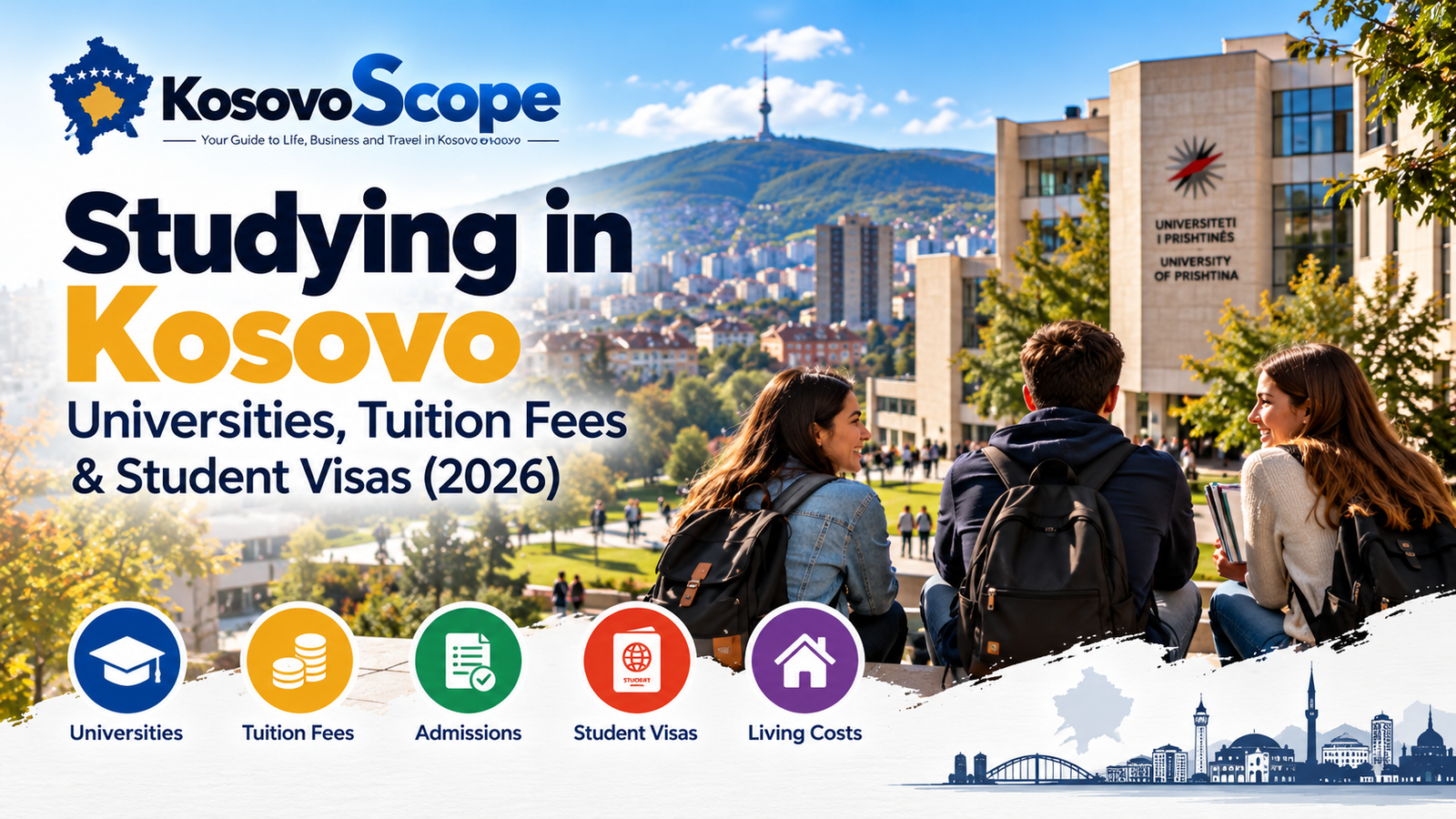
Kosovo is an option for international students considering university education in Southeast Europe. With public universities, private higher education institutions, programmes in several languages and living costs that may be lower than in many Western European cities, the country offers different paths to undergraduate and postgraduate study.
However, choosing to study in Kosovo requires more than comparing tuition fees. International applicants should examine programme accreditation, teaching language, admission requirements, residence procedures and whether their qualification will be recognised in the country where they eventually intend to work or continue their education.
This guide explains what prospective students need to know about studying in Kosovo in 2026, including universities, tuition fees, admissions, accommodation, student residence permits and practical preparations.
1. Understanding Higher Education in Kosovo
Kosovo’s higher education system includes public universities and private institutions offering bachelor’s, master’s and, where authorised, doctoral programmes.
Many institutions use the European Credit Transfer and Accumulation System (ECTS). A standard full-time academic year generally represents 60 ECTS credits, although individual degree structures and requirements vary.
Students can explore fields such as:
- Business, economics and management
- Computer science and information technology
- Engineering and architecture
- Law and political science
- Medicine and health sciences
- Education and social sciences
- Languages, arts and humanities
Not every institution offers every discipline, and not every programme is available in English.
2. Universities in Kosovo
University of Prishtina
The University of Prishtina is one of Kosovo’s principal public universities, located in the capital.
Its academic offerings cover numerous disciplines, and it provides information specifically for international applicants.
Foreign candidates may need to take entrance examinations depending on the programme. Tuition exemptions or other financial arrangements should be verified directly with the university for the relevant admission category.
Official website: https://uni-pr.edu/
RIT Kosovo (A.U.K)
RIT Kosovo is a private, nonprofit higher education institution associated with Rochester Institute of Technology.
It is particularly relevant to students interested in an English-language academic environment and a US-oriented educational model.
Its published 2026 tuition schedule lists annual totals of approximately €6,840–€6,940 under specified early and regular payment arrangements, including certain student fees. Applicants should verify the current schedule and scholarship options.
Official website: https://www.rit.edu/kosovo/
Other Universities and Colleges
Prospective students may also investigate institutions such as:
- University of Prizren
- University of Peja
- UBT
- AAB College
Their suitability depends on the specific programme, campus, teaching language, accreditation status, admission criteria and total cost.
Rather than choosing solely by an institution’s reputation or marketing, applicants should compare the actual degree programmes available for the academic year in which they plan to enrol.
3. Accreditation: The Most Important Check Before Applying
Accreditation is one of the most important considerations when selecting a university in Kosovo.
The Kosovo Accreditation Agency (KAA) is the national authority responsible for quality assurance and accreditation in higher education.
The agency has published a list of accredited programmes for the 2026/2027 academic year, covering public and private institutions and different study cycles.
Before paying an application fee or enrolling, students should confirm:
- The institution’s accreditation status.
- The exact degree programme and study cycle.
- The campus or location covered by accreditation.
- The relevant accreditation period.
- Any professional recognition requirements in their intended destination country.
An accredited institution does not necessarily mean every programme it advertises is currently accredited.
Official accreditation information: https://akreditimi.rks-gov.net/
Accreditation also does not guarantee automatic international recognition of a qualification. Universities, employers and professional regulators abroad may apply separate recognition procedures.
4. Tuition Fees in Kosovo in 2026
Tuition fees vary considerably between public and private institutions.
Public universities may offer tuition exemptions or low-cost study opportunities, while private institutions generally charge programme-specific fees.
| Institution or category | Tuition information |
|---|---|
| University of Prishtina | Certain admitted applicants may qualify for tuition exemptions |
| RIT Kosovo | Approximately €6,840–€6,940 annually under specified published 2026 arrangements |
| Other public universities | Check programme-specific rules and exemptions |
| Other private institutions | Request the official 2026/2027 fee schedule |
When comparing universities, students should consider expenses beyond the advertised tuition:
- Application and entrance examination fees
- Registration and administrative charges
- Textbooks, equipment and software
- Laboratory or practical training expenses
- Health insurance
- Accommodation and living expenses
- Document translation and legalisation costs
- Residence permit expenses, where applicable
A programme with lower tuition is not necessarily the cheapest overall option.
5. Admission Requirements for International Students
Admission requirements depend on the university, academic level, nationality and programme.
Bachelor’s Degree Applications
Applicants may be asked to provide a completed secondary-school qualification, academic transcripts and proof that their previous education meets the institution’s entry requirements.
Depending on the university, additional requirements may include an entrance examination, language assessment or recognition of foreign educational documents.
Master’s Degree Applications
Master’s applicants generally need a relevant undergraduate qualification. Institutions may also request transcripts, evidence of previous academic credits, a motivation letter or other programme-specific documents.
Certain master’s programmes require a degree in a related discipline.
Doctoral Applications
Doctoral programmes may involve additional academic requirements, including previous postgraduate qualifications, a research proposal and evidence of research readiness.
Doctoral availability must be checked individually because not every institution or department is authorised to offer doctoral degrees.
Common Application Documents
International applicants should prepare for the possibility of submitting:
- A valid passport or identification document.
- Previous diplomas and academic transcripts.
- Certified translations of educational documents.
- Recognition or equivalence decisions, where required.
- Language proficiency evidence.
- Entrance examination results.
- A completed university application.
- Additional documents required by the institution.
The exact document list should always be confirmed directly with the university.
6. Can You Study in Kosovo in English?
English-language study is available through certain institutions and programmes, but applicants should not assume that every university offers full degrees in English.
Albanian is widely used in higher education, while Serbian and other languages are used in particular institutions or programmes.
Before applying, students should confirm the language used for lectures, examinations, assignments, practical training and final dissertations.
A programme containing several English-language modules is not necessarily a fully English-taught degree.
Students who do not speak Albanian or Serbian may find an English-language programme more practical academically, although learning basic local-language vocabulary can make daily life easier.
7. Student Visas and Residence Permits in Kosovo
International students must distinguish between permission to enter Kosovo and permission to remain in the country for an extended period.
Requirements depend on nationality, immigration status, intended length of stay and the applicable rules.
Some students may be eligible for visa-free entry for short visits. However, visa-free entry should not be interpreted as automatic permission to reside in Kosovo throughout a university degree.
Students planning long-term education should confirm the applicable study-related residence procedure with Kosovo’s Ministry of Internal Affairs or the relevant diplomatic mission.
Depending on their circumstances, applicants may need evidence of university admission, accommodation, financial resources, health insurance and other supporting documents.
Important: A university acceptance letter does not, by itself, guarantee entry or residence approval.
Applicants should also clarify whether an application must be submitted before travelling or can be completed after lawful entry.
Students should avoid relying on informal advice from other international students because immigration rules and individual circumstances may differ.
For general relocation guidance, see KosovoScope’s Moving to Kosovo guide.
8. Cost of Living for Students in Kosovo
A student’s living expenses depend heavily on their city, housing arrangement and lifestyle.
Prishtina offers access to universities, transport, restaurants, shops and student services, but accommodation costs can vary significantly between neighbourhoods and property types.
Other university cities may offer different rental markets and living conditions.
Example Monthly Student Budget
The following is an illustrative planning scenario, not a verified survey of October 2026 market prices.
| Expense | Monthly planning allowance |
|---|---|
| Shared accommodation | €150–250 |
| Food and groceries | €120–200 |
| Utilities and internet contribution | €25–50 |
| Local transport | €10–30 |
| Phone and personal expenses | €30–70 |
| Illustrative total | €335–600 |
These amounts exclude tuition, initial rental deposits, immigration expenses, international travel and unexpected costs.
A student renting a private apartment rather than sharing accommodation may need a substantially higher budget.
Students should check actual rental advertisements and utility arrangements before committing to a property.
For a broader breakdown of household expenses, see Cost of Living in Kosovo: Complete Guide for 2026.
9. Student Accommodation in Kosovo
Accommodation is an important part of preparing for university life.
International students generally need to investigate whether their chosen institution offers student housing or whether they must arrange accommodation privately.
Student Dormitories
University-associated or public student housing may be available subject to eligibility, capacity and application deadlines.
International students should confirm whether they qualify rather than assuming that admission automatically includes accommodation.
Shared Apartments
Sharing an apartment can reduce individual housing costs and provide opportunities to meet other students.
Before signing a lease, students should clarify how rent, electricity, heating, water and internet bills are divided.
Private Apartments
Private accommodation offers greater independence but can involve higher monthly costs, deposits and utility responsibilities.
Students should inspect the property where possible and request written confirmation of the rental terms.
For additional guidance on evaluating properties, KosovoScope’s Living in Kosovo guide covers practical aspects of settling into the country.
10. Healthcare and Health Insurance for Students
Healthcare arrangements should be checked before arriving in Kosovo.
International students should ask whether their university provides access to particular medical services or requires evidence of private health insurance.
Coverage should be evaluated carefully, particularly for emergencies, specialist treatment, prescriptions and any planned travel outside Kosovo.
Students with ongoing medical needs should check the availability of suitable care before choosing a university city.
For general information, see KosovoScope’s Healthcare in Kosovo guide.
11. Scholarships and Financial Support
Scholarships can make studying in Kosovo more affordable, but availability varies by institution, academic year and applicant category.
Possible funding sources include university merit awards, financial-need assistance, exchange programmes and externally funded educational initiatives.
Students should check whether funding covers only tuition or also contributes toward accommodation and living expenses.
Applicants should ask the university whether a scholarship is automatically considered during admission or requires a separate application.
They should also confirm renewal conditions, minimum academic performance requirements and whether the scholarship remains available throughout the degree.
12. Erasmus+ and International Exchange Opportunities
Students interested in international mobility should investigate whether their university participates in Erasmus+ projects or maintains bilateral agreements with universities abroad.
Exchange opportunities can provide academic and cultural experience, but participation depends on institutional agreements, eligibility rules and available funding.
Students should not assume that every Kosovo university programme includes a guaranteed semester abroad.
Before selecting a university, ask its international relations office about current partnerships, credit transfer, exchange destinations and funding opportunities.
13. Are Kosovo University Degrees Recognised Abroad?
Degree recognition is one of the most important issues for international students.
A degree awarded by an accredited Kosovo institution may be assessed for recognition abroad, but the outcome depends on the destination country, receiving institution and intended purpose.
Academic recognition for postgraduate admission may differ from professional recognition for employment.
Regulated professions, including medicine, nursing, law and certain engineering occupations, can involve additional licensing or qualification requirements.
Students intending to work abroad should contact the relevant recognition authority before enrolling, especially if their intended career requires a professional licence.
14. Can International Students Work While Studying?
Students should not assume that holding a study-related residence permit automatically grants unrestricted employment rights.
The ability to work may depend on nationality, immigration status, employment arrangements and applicable labour and migration rules.
Before accepting paid employment, international students should confirm whether separate authorisation is necessary.
Remote work and freelance activities may also create immigration, business-registration or tax considerations.
For related information, KosovoScope provides guides to Jobs in Kosovo for Foreigners and Freelancing in Kosovo.
15. Student Life in Prishtina and Other University Cities
University life in Kosovo extends beyond classrooms.
Prishtina offers a concentration of educational institutions, cafes, cultural venues, businesses and social activities.
Prizren combines university life with a historic urban environment, while Peja offers access to mountain landscapes and outdoor activities.
The right location depends on the programme, budget, personal preferences and language requirements.
Students should also investigate public transport, internet connectivity, access to healthcare and the distance between their accommodation and university campus.
16. How to Apply to a University in Kosovo: Step-by-Step
- Choose your degree and university. Compare academic programmes, teaching languages, tuition and career relevance.
- Verify accreditation. Check the exact programme against the official Kosovo Accreditation Agency list.
- Review admission requirements. Confirm eligibility, required qualifications, entrance examinations and application deadlines.
- Prepare your documents. Arrange transcripts, translations and recognition procedures where necessary.
- Submit the application. Follow the university’s official admissions process and retain confirmation of submission.
- Review the admission offer. Check tuition, payment deadlines, programme language and any conditions.
- Arrange immigration documentation. Confirm visa and residence requirements with the relevant authorities.
- Plan accommodation and finances. Budget for rent, deposits, utilities, food, insurance and initial expenses.
- Complete enrolment. Attend required registration, orientation and administrative appointments.
17. Common Mistakes International Students Should Avoid
One of the biggest mistakes is enrolling without verifying programme accreditation.
Other common risks include assuming that all programmes are available in English, overlooking document recognition requirements, underestimating accommodation costs and misunderstanding immigration conditions.
Students should also be cautious about agencies or intermediaries promising guaranteed admission, visas or international degree recognition.
Where possible, communicate directly with the university’s official admissions office and use verified institutional payment channels.
Frequently Asked Questions About Studying in Kosovo
Is Kosovo a good place for international students?
Kosovo may be suitable for students looking for particular academic programmes, a Southeast European living experience or comparatively affordable living arrangements. The decision should depend on programme quality, accreditation, language, costs and future career plans.
Is university education free in Kosovo?
Some public university arrangements offer tuition exemptions. However, this should not be generalised to every institution or applicant category. Students must check the current tuition policy of their chosen university.
Can foreigners study in Kosovo?
Yes. Foreign applicants can seek admission to Kosovo higher education institutions, subject to their academic eligibility, institutional requirements and applicable immigration rules.
Can I study in English in Kosovo?
Yes, certain institutions and programmes offer English-language study. However, students must verify the teaching and examination language for their exact degree.
How much does it cost to study in Kosovo?
Costs vary considerably. Some public university applicants may qualify for tuition exemptions, while private institutions can charge several thousand euros annually. Living expenses, accommodation and additional academic fees must also be considered.
Are Kosovo university degrees recognised internationally?
Recognition is not automatic. It depends on the institution, programme, accreditation, destination country and intended academic or professional use.
Do international students need a residence permit?
Students intending to stay for an extended period may need a study-related residence authorisation. Requirements depend on nationality and circumstances and should be checked with Kosovo’s immigration authorities.
Final Thoughts: Is Studying in Kosovo Worth Considering in 2026?
Studying in Kosovo can be an option for international students seeking university education in Southeast Europe, particularly those who find a suitable accredited programme matching their academic and financial goals.
The most important decision is not simply which university has the lowest tuition fee or the most attractive campus.
Students should prioritise programme accreditation, admission eligibility, teaching language, total costs and the future recognition of their qualification.
By researching these factors before applying, prospective students can make a better-informed decision about whether university education in Kosovo fits their plans.