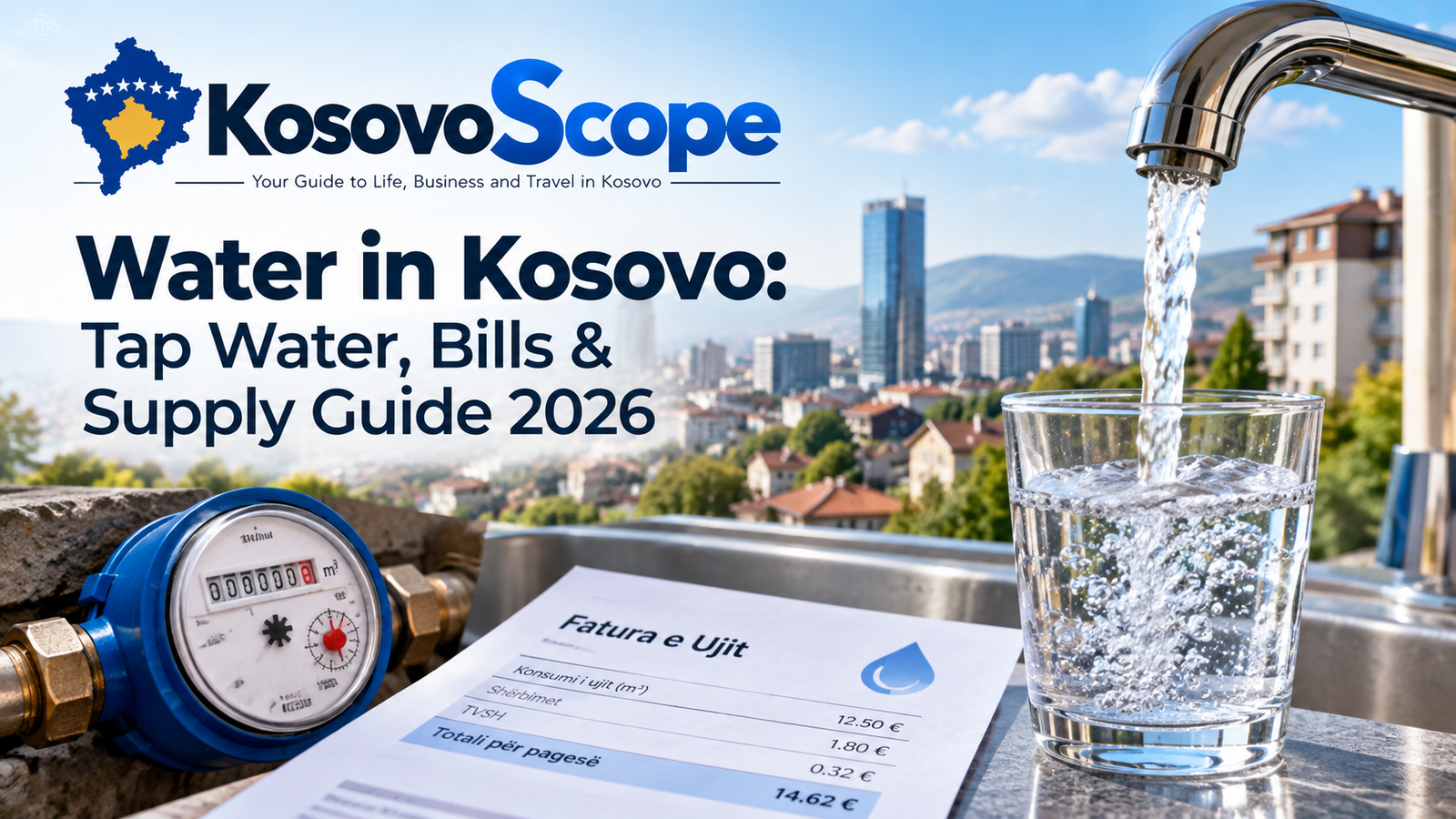
Water supply is one of the most basic services to understand when living in Kosovo, especially if you are renting an apartment, buying property or moving to a new city.
The system is organized through regional water companies rather than one nationwide household provider. Different companies serve Pristina, Prizren, Peja, Gjakova, Mitrovica, Gjilan, Ferizaj and surrounding municipalities, while tariffs are regulated by Kosovo’s Water Services Regulatory Authority.
In 2026, Kosovo’s regulator renewed the service licences of the seven regional water companies for another five-year period, from September 2026 to September 2031. Arru Rks
This guide explains how water supply works in Kosovo, who provides it, how bills are calculated, whether tap water is drinkable, what to do during supply interruptions and what tenants and homeowners should check before moving into a property.
Who Regulates Water Services in Kosovo?
Water and wastewater services are regulated by the Water Services Regulatory Authority, known in Albanian as ARRU.
ARRU is responsible for areas including:
- Licensing water companies
- Approving service tariffs
- Monitoring service providers
- Consumer protection
- Regulatory standards
ARRU publishes tariff orders for each regional water company and also handles the licensing framework for public water and wastewater services. Arru Rks
Which Water Companies Operate in Kosovo?
Kosovo currently has seven licensed regional water companies providing public water and wastewater services.
They include:
- KRU Prishtina
- KRU Hidroregjioni Jugor
- KRU Hidrodrini
- KRU Mitrovica
- KRU Gjakova
- KRU Hidromorava
- KRU Bifurkacioni
ARRU also regulates the bulk-water provider Ibër-Lepenci. Arru Rks
The company you deal with depends on where you live.
Which Company Serves Pristina?
Pristina and several surrounding municipalities are served by KRU Prishtina.
ARRU lists its service area as including:
- Prishtina
- Fushë Kosova
- Obiliq
- Podujeva
- Lipjan
- Gllogoc
- Shtime
- Gračanica Arru Rks
If you live in Pristina, KRU Prishtina is usually the company responsible for your public water supply and wastewater service.
What About Other Cities?
Other regional providers include:
Prizren
KRU Hidroregjioni Jugor serves Prizren and several nearby municipalities.
Peja
KRU Hidrodrini serves Peja and surrounding areas.
Gjakova
KRU Gjakova serves Gjakova and nearby municipalities.
Mitrovica
KRU Mitrovica serves the Mitrovica region.
Gjilan
KRU Hidromorava serves Gjilan and nearby areas.
Ferizaj
KRU Bifurkacioni serves Ferizaj and surrounding municipalities.
This regional structure means water prices and service conditions can differ depending on where you live.
Water Tariffs in Kosovo in 2026
There is no single national household water price.
ARRU sets separate tariff orders for each regional water company.
For 2026, ARRU published individual tariff orders for:
- Prishtina
- Hidroregjioni Jugor
- Hidrodrini
- Mitrovica
- Gjakova
- Bifurkacioni
- Hidromorava
- Ibër-Lepenci
ARRU later published amended 2026 tariff orders in April 2026. Arru Rks
Because tariffs vary by provider, residents should check the current ARRU tariff order for their specific region rather than relying on a national average.
How Is a Water Bill Calculated?
A typical household water bill may include:
- Fixed monthly charge
- Water consumption charge
- Wastewater charge
- Metered consumption
The exact structure depends on the regional provider and tariff order.
Water consumption is usually calculated in cubic meters.
1 cubic meter = 1,000 liters
If your household uses 10 m³ in a month, that means approximately 10,000 liters of water.
Water and Wastewater Are Often Billed Together
Many households pay not only for water supply but also for wastewater services.
This means your total bill may include:
- Water supply
- Wastewater/sewerage service
- Fixed service charges
Do not assume the volumetric water rate is the entire bill.
How Much Water Does a Household Use?
Consumption varies widely.
A household uses water for:
- Showers
- Toilets
- Washing machine
- Dishwasher
- Cooking
- Cleaning
- Drinking
- Garden watering
A family with several people may use significantly more water than one person living alone.
Leaks can also increase consumption dramatically.
Check Your Meter Regularly
If you have an individual meter, monitor it.
A simple habit is to record the meter reading once per month.
This helps you identify:
- Unusually high consumption
- Hidden leaks
- Billing errors
- Changes in household use
If your bill suddenly increases, check the meter before assuming the tariff changed.
How to Check for a Water Leak
One simple test:
- Turn off all taps.
- Stop the washing machine and dishwasher.
- Make sure no toilet is filling.
- Check the water meter.
- Wait.
- Check again.
If the meter continues moving when no water is being used, there may be a leak.
Common leak sources include:
- Toilets
- Old taps
- Internal pipes
- Water heaters
- Underground pipes
Even a small leak can waste a surprising amount of water over time.
Is Tap Water Safe to Drink in Kosovo?
There is no responsible one-word answer for every location.
Public water supplied through regional networks is treated and managed as a regulated public service, but actual drinking-water conditions can vary by:
- Municipality
- Neighborhood
- Building
- Internal plumbing
- Temporary maintenance
- Supply interruption
- Local water-quality advisories
For that reason, travelers and residents should follow current information from the relevant regional water company and local public-health authorities.
If there has been a recent interruption or contamination advisory, do not assume the water is immediately suitable for drinking when supply returns.
Why Can Water Quality Differ Between Buildings?
Even if municipal water enters the area in good condition, the final water from your tap can also be affected by:
- Old building pipes
- Rust
- Private water tanks
- Poor tank maintenance
- Building-level plumbing
- Long periods of stagnation
This is especially relevant in older apartment buildings.
If water has an unusual:
- Color
- Smell
- Taste
- Sediment
stop and investigate before drinking it.
Bottled Water in Kosovo
Bottled water is widely available.
Many residents and visitors use bottled water for drinking even when using tap water for:
- Cooking
- Cleaning
- Showering
- Washing
Whether this is necessary depends on the local supply and personal preference.
If you are new to an area, asking neighbors what they normally do can provide useful local context.
Water Filters
Some households use:
- Jug filters
- Tap filters
- Under-sink filters
- Whole-house filtration
A filter may improve:
- Taste
- Odor
- Sediment
But a basic consumer filter does not automatically make unsafe water safe from every possible contaminant.
Use a filtration system that matches the actual issue.
Water Supply Interruptions
Water interruptions can happen because of:
- Pipe repairs
- Network maintenance
- Pump problems
- Reservoir issues
- Electricity interruptions
- Infrastructure upgrades
- Emergency faults
Regional water companies may publish notices when planned interruptions affect specific areas.
What Should You Do During a Water Outage?
First determine whether the issue affects:
- Only your apartment
- Your building
- Your street
- A larger area
If only your apartment is affected, check:
- Internal valves
- Building supply
- Water tank
- Pump system
If neighbors are also affected, contact or check the relevant regional water company.
What Happens When Water Returns?
After an interruption, you may notice:
- Air in pipes
- Temporary discoloration
- Sediment
- Pressure changes
Let the cold water run briefly until it becomes clear.
If the regional water company has issued a specific advisory, follow that guidance instead.
Low Water Pressure
Low pressure can have several causes:
- Network conditions
- High demand
- Building height
- Pump issues
- Internal plumbing
- Partially closed valves
Top-floor apartments may experience more pressure issues than lower floors in some buildings.
Before renting, turn on:
- Shower
- Kitchen tap
- Bathroom tap
and check whether pressure is acceptable.
Water Tanks in Apartment Buildings
Some buildings use private tanks or storage systems.
This can help during temporary supply interruptions.
But tanks need maintenance.
Ask:
- Does the building have a water tank?
- How large is it?
- Is it cleaned regularly?
- Who maintains it?
- How long can it supply the building?
A poorly maintained tank can create its own water-quality problems.
Water Pumps
Some buildings use pumps to maintain pressure.
If a building depends heavily on a pump, electricity outages can affect water pressure or supply.
This is another reason why electricity and water infrastructure can sometimes be connected in practice.
Link this section to your Electricity in Kosovo guide.
Renting an Apartment: What to Check
Before signing a lease, ask:
- Is water included in rent?
- Is there an individual meter?
- Who pays the bill?
- Are there outstanding water debts?
- Is water available 24/7?
- Is there a building tank?
- Is pressure good on the current floor?
- Are there known supply interruptions?
This takes only a few minutes but can prevent problems later.
Link this section to Renting an Apartment in Kosovo.
Check for Old Water Debt
When renting or buying property, ask whether the account has outstanding debt.
Do not assume a connected property has a clean payment history.
Ask for:
- Recent bills
- Proof of payment
- Account status
This is especially important when taking over a long-term tenancy.
Buying Property: Water Infrastructure Matters
When buying a property, check:
- Public water connection
- Meter ownership
- Wastewater connection
- Water pressure
- Pipe condition
- Building tank
- Pump system
- Previous water bills
A beautiful apartment with weak pressure or poor building plumbing can quickly become frustrating.
Link this section to Buying Property in Kosovo.
Rural Areas
Not every settlement in Kosovo is connected in exactly the same way to the regional public water network.
ARRU’s historical performance reporting has noted that while regional providers serve most municipalities, some settlements, particularly rural ones, may fall outside standard public-network coverage. Arru Rks
Rural properties may use:
- Wells
- Local supply systems
- Springs
- Private reservoirs
These systems require more careful water-quality assessment.
Private Wells
If you are buying a rural house with a private well, do not assume the water is safe because it looks clean.
Consider laboratory testing for:
- Bacteria
- Nitrates
- Minerals
- Chemical contamination
Well water quality can change over time.
Hot Water in Kosovo Homes
Domestic hot water is commonly produced using:
- Electric boiler
- Central heating system
- Heat pump
- Solar thermal
- Combined systems
Electric boilers are common and can add to electricity consumption.
If you are renting, ask:
- How large is the boiler?
- How long does it take to heat?
- How old is it?
- Does it leak?
- Is hot water pressure good?
Water and Electricity Costs Are Connected
A water bill itself may be relatively manageable, but hot water can create a significant electricity cost.
For example:
Long showers increase both:
- Water consumption
- Electricity used to heat the water
So reducing hot-water use can lower two household expenses at once.
Water-Saving Tips
Simple measures include:
Fix leaks
A leaking toilet or tap can waste large amounts of water.
Shorter showers
One of the easiest ways to reduce usage.
Full washing-machine loads
Avoid running half-empty cycles.
Full dishwasher loads
Use efficient modes where possible.
Turn off taps
Do not leave water running while brushing teeth or washing dishes unnecessarily.
Use efficient fixtures
Low-flow showerheads and aerators can reduce consumption.
How to Read a Water Bill
Look for:
- Billing period
- Previous meter reading
- Current meter reading
- Consumption in m³
- Water tariff
- Wastewater tariff
- Fixed charge
- Previous balance
- Final amount due
If the reading looks unrealistic, compare it with the physical meter.
Paying Water Bills
Payment methods depend on the regional company and may include:
- Banks
- Online banking
- Payment offices
- Provider payment points
- Other electronic channels
Keep payment receipts, particularly if paying close to the due date.
What Happens If You Do Not Pay?
Persistent unpaid bills can lead to collection or service-related consequences according to applicable regulations.
ARRU regulates consumer-service relationships and service providers operate under formal regulatory rules. Arru Rks
If you cannot pay a bill or believe it is incorrect, contact the provider instead of ignoring it.
Disputing a Water Bill
If a bill appears wrong:
- Photograph the meter.
- Check previous bills.
- Compare consumption.
- Contact the water company.
- Keep written evidence.
- Escalate through the appropriate consumer complaint process if necessary.
ARRU also provides a consumer-protection role in the regulated water sector. Arru Rks
Water Service Licences in 2026
ARRU renewed the licences of the seven regional water companies and the bulk-water supplier in September 2026.
The new licences run from:
11 September 2026 to 10 September 2031 Arru Rks
This confirms the current regulatory structure of Kosovo’s water sector.
Why Tariffs Can Change
Water tariffs are periodically reviewed because companies must finance:
- Water treatment
- Distribution
- Maintenance
- Repairs
- Energy
- Staff
- Wastewater services
- Infrastructure investment
ARRU reviews tariff applications and sets approved tariffs under its regulatory framework.
For 2026, new tariff orders were published at the end of 2025 and amended during 2026. Arru Rks
Water and Cost of Living
Water is part of the overall monthly household budget, but it is usually only one component.
Other major utilities include:
- Electricity
- Heating
- Internet
- Building maintenance
- Waste collection
Link this section to your Cost of Living in Kosovo guide.
Water for Remote Workers
Water reliability matters more than people sometimes expect.
If you work from home, repeated interruptions can affect:
- Cooking
- Toilets
- Washing
- Daily routine
Before renting long term, ask neighbors whether supply interruptions are common in that specific building or area.
Moving to Kosovo: Water Checklist
Before moving in:
Provider
Identify the regional water company.
Account
Confirm the account holder.
Debt
Check for unpaid balances.
Meter
Photograph the meter reading.
Pressure
Test multiple taps.
Hot water
Check the boiler.
Supply
Ask about interruptions.
Storage
Check whether the building has a tank.
Quality
Ask whether residents normally drink tap water.
This simple checklist can save you a lot of frustration.
Common Water Mistakes
Avoid:
- Assuming every city uses the same tariff
- Ignoring previous bills
- Renting without checking pressure
- Assuming tap water conditions are identical everywhere
- Ignoring building tanks
- Failing to check for leaks
- Confusing water supply charges with the total bill
- Forgetting wastewater charges
- Buying rural property without checking the water source
Is Water Expensive in Kosovo?
There is no single national figure because prices are regional.
ARRU publishes separate tariff orders for each water company.
The best way to estimate your cost is:
- Identify your provider.
- Check its current tariff order.
- Estimate your monthly cubic-meter usage.
- Include wastewater and fixed charges.
This gives a much more accurate result than using a national average.
Final Thoughts
Water services in Kosovo are organized through seven regional water companies regulated by ARRU.
For residents, the most important things to understand are:
- Your provider depends on where you live.
- Water tariffs vary by region.
- Bills may include both water and wastewater charges.
- Meter readings should be checked regularly.
- Supply interruptions can occur because of maintenance or infrastructure issues.
- Tap-water conditions should be judged locally and according to current official guidance.
- Tenants should check water pressure, previous bills and outstanding debt before moving in.
ARRU renewed the licences of Kosovo’s regional water companies in September 2026 for another five years, while 2026 tariffs are published separately for each provider. Arru Rks
Understanding the local system makes it much easier to avoid billing surprises and choose a property with reliable water service.
[…] this section to your Water in Kosovo […]