
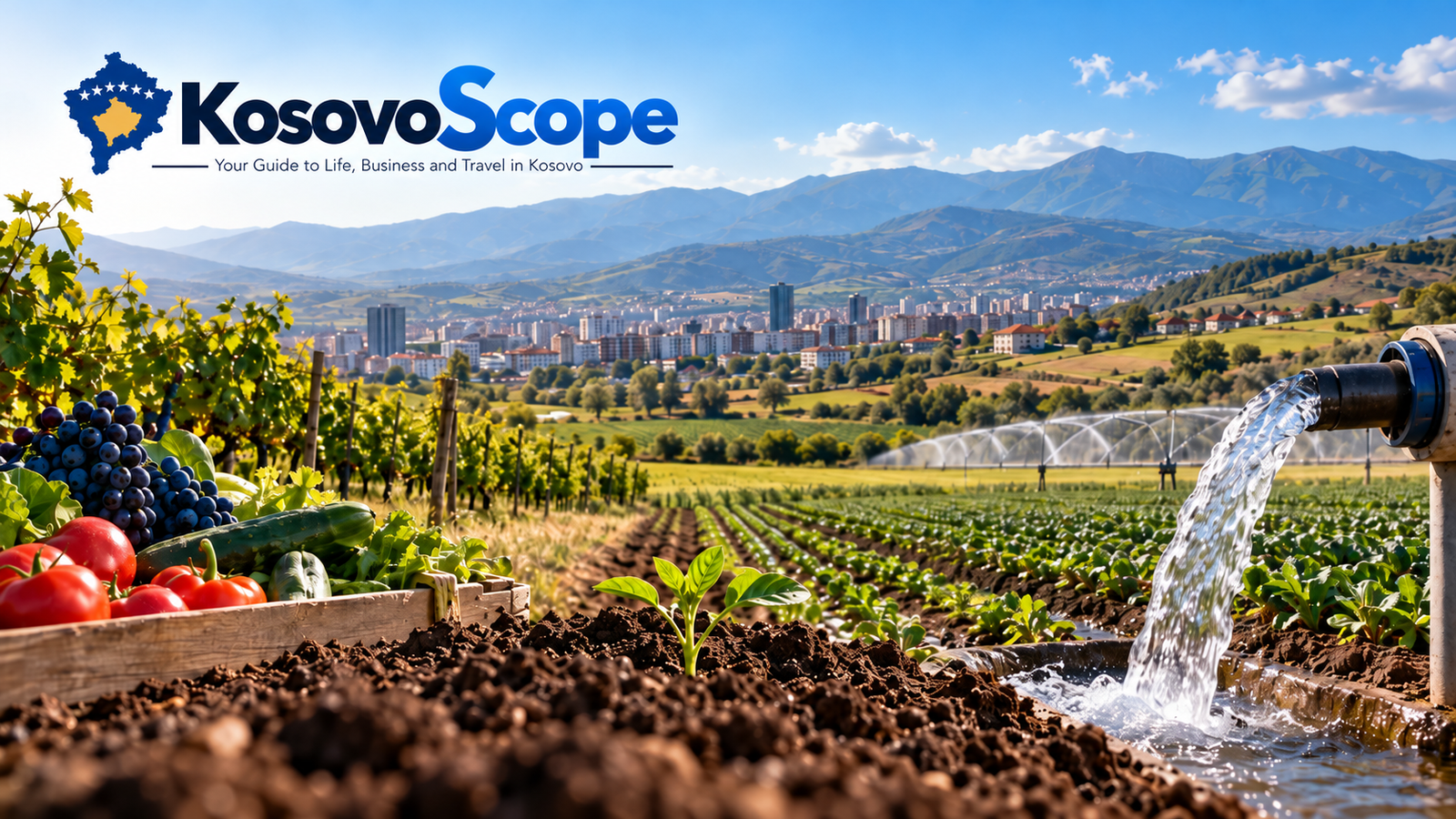
Farming in Kosovo can be attractive for people interested in crop production, orchards, vineyards, vegetables, livestock or mixed farming.
But agricultural land should never be judged only by its size, price or location.
Two plots only a few kilometers apart can have very different:
- Soil quality
- Water access
- Drainage
- Irrigation potential
- Frost exposure
- Slope
- Road access
- Crop suitability
The most important rule is simple:
Do not buy agricultural land in Kosovo before checking both the soil and the water.
This 2026 guide explains soil quality, irrigation, groundwater, farming regions, suitable crops, subsidies and the practical checks that should be completed before investing in agricultural land.
Is Kosovo Good for Agriculture?
Agriculture remains an important part of Kosovo’s rural economy.
The country has a combination of:
- Fertile plains
- River valleys
- Mountain areas
- Vineyards
- Orchards
- Pasture
- Vegetable-growing zones
Different regions are better suited to different types of farming.
Kosovo’s Ministry of Agriculture continues to support agricultural production through subsidies, rural-development programs and irrigation projects. For 2026, the ministry approved an annual agricultural support framework worth approximately €77.5 million. mbpzhr
That support includes direct payments, rural investment and sector-development measures.
Where Is the Best Agricultural Land in Kosovo?
There is no single “best” farming region.
The right area depends on what you want to grow.
Broadly, Kosovo’s agricultural landscape includes:
- Central and eastern plains
- Dukagjini / western Kosovo
- Rahovec wine region
- River valleys
- Higher-elevation areas
- Mountain pasture zones
The western part of Kosovo generally receives more precipitation, while eastern areas can be relatively drier.
This matters when choosing land for crops that depend heavily on irrigation.
Dukagjini Region
The Dukagjini plain includes areas around:
- Peja
- Gjakova
- Deçan
- Klina
- Istog
- Rahovec
This region is important for:
- Fruit
- Vegetables
- Vineyards
- Cereals
- Livestock
- Mixed farming
It also benefits from important irrigation infrastructure.
The Ministry of Agriculture continued investing in irrigation systems around Istog in 2026, including rehabilitation of a major irrigation canal intended to improve water supply for agricultural land. mbpzhr
For investors interested in higher-value crops, western Kosovo deserves serious consideration.
Rahovec and Vineyards
Rahovec is strongly associated with:
- Grapes
- Vineyards
- Wine production
- Fruit growing
The combination of agricultural tradition, climate and established wine infrastructure makes the area particularly relevant for viticulture.
However, buying a vineyard or planting new vines still requires proper soil analysis.
Check:
- Soil drainage
- pH
- Calcium
- Organic matter
- Slope
- Exposure to sunlight
- Frost risk
- Water availability
Do not assume every piece of land near Rahovec is automatically good vineyard land.
Central Kosovo
Areas around:
- Lipjan
- Fushë Kosovë
- Drenas
- Pristina outskirts
include important agricultural plains.
These areas can be suitable for:
- Wheat
- Corn
- Vegetables
- Animal feed
- Greenhouses
- Mixed farming
Access to roads and markets can be an advantage.
However, urban expansion around Pristina means some agricultural land may also face development pressure.
Podujeva Region
Podujeva is particularly important for cereal production.
In July 2026, Kosovo’s Ministry of Agriculture reported strong wheat yields in Podujeva, with preliminary averages of around 4–5 tonnes per hectare, and some areas performing above that level. mbpzhr
That does not mean every field will achieve these yields.
Yield depends on:
- Soil fertility
- Seed variety
- Rainfall
- Fertilization
- Disease control
- Farm management
- Irrigation where available
But the area clearly remains significant for grain farming.
Mitrovica and Northern Agricultural Areas
Agricultural development is also expanding around Mitrovica.
In June 2026, a new irrigation agreement was announced for villages around Mitrovica, covering approximately 500 hectares of agricultural land. mbpzhr
This is important because irrigation access can dramatically change the economic potential of farmland.
Land that is suitable only for lower-value rain-fed crops may become much more valuable when reliable irrigation is available.
Soil Quality in Kosovo
Soil is one of the most important factors in agricultural investment.
Kosovo contains multiple soil types, so general statements such as “Kosovo has fertile soil” are not enough when buying a specific plot.
You need to test the actual land.
A professional soil analysis should ideally measure:
- pH
- Organic matter
- Nitrogen
- Phosphorus
- Potassium
- Calcium
- Salinity
- Soil texture
Depending on the crop, additional micronutrient testing may also be useful.
Why Soil pH Matters
Different crops prefer different pH ranges.
If the soil is too acidic or too alkaline, plants may struggle to absorb nutrients even if fertilizer is present.
This can result in:
- Weak growth
- Low yields
- Nutrient deficiencies
- Higher fertilizer costs
Before planting an orchard, vineyard or other long-term crop, soil pH should be tested.
Correcting soil after planting permanent crops can be much more difficult and expensive.
Soil Texture
Soil is commonly described as a mixture of:
- Sand
- Silt
- Clay
Each behaves differently.
Sandy soil
Drains quickly but may lose water and nutrients.
Clay soil
Can retain nutrients and moisture but may suffer from poor drainage.
Loamy soil
Often offers a useful balance for many crops.
The right soil depends on the crop.
For example, a plot suitable for vegetables may not be ideal for every orchard or vineyard.
Soil Drainage
Drainage is one of the most underestimated issues when buying farmland.
A field can look perfect in summer and become waterlogged after heavy winter or spring rain.
Poor drainage can lead to:
- Root diseases
- Crop loss
- Machinery problems
- Delayed planting
- Soil compaction
Always inspect the land after rain if possible.
Ask neighboring farmers:
- Does water stay on the field?
- Does the area flood?
- How long does the soil remain wet?
- Are drainage channels available?
Do a Soil Test Before Buying
For serious agricultural investment, take samples before finalizing the land purchase.
A proper sampling plan should collect soil from several points across the property.
One sample from one corner is not enough for a large field.
For bigger farms, divide land into zones based on:
- Slope
- Previous crop
- Soil color
- Drainage
- Elevation
Then test separately.
Water Is Often More Important Than Soil
Good soil without reliable water can severely limit agricultural production.
Kosovo’s water resources are not unlimited.
The World Bank has highlighted that Kosovo relies heavily on its own internal water resources and that irrigation development is important for reducing climate risk and supporting commercial agriculture. world bank
This makes water due diligence essential.
Main Sources of Agricultural Water
Farmers in Kosovo may use:
- Formal irrigation networks
- Rivers
- Canals
- Reservoir systems
- Wells
- Springs
- Private storage
- Rain-fed agriculture
The best option depends on the location.
A property advertisement saying “water nearby” is not enough.
You need to know whether you actually have a legal, reliable and economically usable water source.
Formal Irrigation Systems
Kosovo has organized irrigation systems serving parts of the country.
The major systems include areas connected to infrastructure such as:
- Ibër-Lepenc
- Radoniqi / Dukagjini irrigation systems
- Regional irrigation canals
Formal irrigation can provide a major advantage for commercial production.
Before buying land, ask:
- Is the parcel inside the irrigation service area?
- Is there an active connection?
- How much does irrigation cost?
- Is water available throughout summer?
- Is the infrastructure functioning?
- Is there a waiting list or connection requirement?
Never assume that a visible canal means you automatically have irrigation rights.
Irrigation Investment Is Expanding
Kosovo is continuing to invest in irrigation.
In 2026, projects included:
- Expansion of irrigation around Mitrovica covering around 500 hectares
- Rehabilitation of irrigation infrastructure in Istog mbpzhr
These investments show that irrigation remains a major agricultural-development priority.
Wells and Groundwater
Some farms rely on wells.
Before buying land based on the idea of drilling a well, investigate:
- Groundwater depth
- Neighboring wells
- Water quantity
- Water quality
- Drilling cost
- Pumping cost
- Legal requirements
A nearby farmer having a productive well does not guarantee identical conditions on your property.
Groundwater can vary significantly over short distances.
Test Well Water
Agricultural water quality can affect crops and soil.
Water testing may examine:
- Salinity
- pH
- Nitrates
- Minerals
- Microbiological contamination
Salty or otherwise unsuitable irrigation water can damage both plants and soil over time.
For livestock, drinking-water quality is also important.
Springs
Some rural and mountain properties may have spring water.
A spring can be valuable, but verify:
- Does it flow year-round?
- Does the flow decrease in summer?
- Who legally owns or controls the source?
- Do neighboring properties use it?
- Is storage required?
Visit in late summer if possible.
A strong spring in April may be much weaker in August.
Rain-Fed Farming
Not all agriculture requires irrigation.
Cereals such as wheat can often be grown under rain-fed conditions.
However, climate variability increases production risk.
Commercial vegetables, berries and many fruit crops generally benefit substantially from reliable irrigation.
Drip Irrigation
For many crops, drip irrigation can improve water efficiency.
It is especially useful for:
- Orchards
- Vineyards
- Vegetables
- Berries
- Greenhouses
Advantages include:
- Less water waste
- More precise irrigation
- Fertigation
- Reduced leaf wetting
- Lower weed growth between rows
Initial installation adds cost, but water savings can be significant.
Irrigation Is Critical for High-Value Crops
Reliable irrigation is especially important for crops such as:
- Tomatoes
- Peppers
- Cucumbers
- Strawberries
- Raspberries
- Orchards
- Greenhouse crops
Water stress at critical growth stages can seriously reduce quality and yield.
Do not build a commercial vegetable business around uncertain summer water.
Which Crops Are Common in Kosovo?
Important agricultural crops include:
- Wheat
- Corn
- Potatoes
- Beans
- Peppers
- Tomatoes
- Grapes
- Apples
- Raspberries
- Other fruits and vegetables
The Ministry specifically continued support for many of these sectors in 2026. mbpzhr
Wheat
Wheat is one of Kosovo’s important strategic crops.
It is particularly suitable for larger field operations where machinery and land consolidation make production more efficient.
Key factors include:
- Seed quality
- Soil fertility
- Disease management
- Fertilization
- Harvest timing
Margins can be relatively tight, so scale matters.
Corn
Corn is important both for food and livestock production.
The Ministry emphasized corn as an important economic and strategic crop in its 2026 spring planting guidance. mbpzhr
Corn production benefits from:
- Good soil fertility
- Appropriate planting density
- Adequate moisture
- Weed control
In dry periods, irrigation can significantly improve yields.
Vegetables
Vegetable farming can generate higher income per hectare than cereals but requires much more management.
Typical crops include:
- Peppers
- Tomatoes
- Cucumbers
- Onions
- Cabbage
- Beans
Vegetables generally require:
- Reliable irrigation
- Labor
- Market access
- Storage
- Disease management
A small irrigated plot near a strong market can sometimes be more profitable than a much larger dry field.
Greenhouses
Greenhouse production allows:
- Earlier harvests
- Longer season
- Better temperature control
- Higher-value production
But greenhouses require investment in:
- Structure
- Irrigation
- Heating where applicable
- Ventilation
- Fertilization
- Labor
Do not build greenhouses before confirming water supply.
Orchards
Fruit production can include:
- Apples
- Plums
- Cherries
- Pears
- Berries
Orchards are long-term investments.
Before planting, investigate:
- Frost pockets
- Soil drainage
- Water
- Pollination
- Variety selection
- Market demand
Because trees remain for many years, mistakes made at planting can be expensive.
Raspberries
Kosovo has developed an important raspberry sector.
The 2026 subsidy program increased support for raspberry cultivation by 20% compared with the previous support level. mbpzhr
Raspberries can be profitable but require:
- Irrigation
- Labor
- Cold-chain management
- Reliable buyers
Do not plant large areas without first knowing who will purchase the crop.
Potatoes and Beans
The 2026 subsidy changes also increased support for potatoes and beans by 20%. mbpzhr
These crops may be interesting depending on:
- Soil type
- Rotation
- Machinery
- Market access
Potatoes in particular require good soil preparation and disease management.
Agricultural Subsidies in 2026
Kosovo continues to provide direct agricultural support.
The 2026 program included increases such as:
- 30% higher support for open-field and greenhouse vegetables
- 30% higher support for fruit-growing areas
- 20% increase for high-yield wheat
- 20% increase for raspberries
- 20% increase for potatoes and beans
- 10% increase for vineyards
- €100 per hectare support for fertilizer
- €54 per hectare support for fuel
- Additional €500 support for qualifying new farmers aged 18–29 mbpzhr
Eligibility rules matter.
Never base a farm business plan on receiving subsidies until you confirm the specific program and requirements.
Start With Market Demand
Do not choose crops only because they grow well.
Ask:
Who will buy them?
Before planting, research:
- Local wholesale markets
- Supermarkets
- Restaurants
- Processors
- Exporters
- Collection centers
A high-yield crop without a buyer can still lose money.
Distance to Market
Transport affects agricultural profitability.
Land closer to:
- Pristina
- Prizren
- Peja
- Gjakova
- Major roads
may have advantages for fresh vegetables and other perishable products.
Fresh produce loses value quickly if it spends too long in transport.
Road Access to the Field
Inspect access carefully.
Ask:
- Can a tractor enter?
- Can a truck reach the property?
- Is the road usable after rain?
- Is there legal road access?
A cheap field with poor access can create permanent logistical problems.
Electricity on Agricultural Land
Electricity can become important for:
- Irrigation pumps
- Greenhouses
- Cold storage
- Processing
- Farm buildings
Find out how far the nearest electrical connection is.
Installing new infrastructure can be expensive.
Link this section to your Electricity in Kosovo guide.
Land Ownership
Before buying agricultural land, verify:
- Cadastral parcel
- Registered owner
- Boundaries
- Mortgage or lien
- Co-ownership
- Inheritance issues
- Legal access road
Do not rely only on what the seller shows you physically.
The cadastral map and legal documents should match the land you are inspecting.
Agricultural Land and Construction
Agricultural land should not automatically be assumed suitable for building.
If you plan to build:
- Farm storage
- Greenhouse
- House
- Processing facility
- Livestock building
check municipal planning and agricultural-land rules first.
Do not buy farmland assuming you can later convert it into construction land.
Land Fragmentation
One challenge in Kosovo agriculture can be fragmented land ownership.
Owning five hectares in one continuous block is often much easier to farm than five hectares spread across multiple separate parcels.
Large machinery becomes inefficient when plots are scattered.
Before buying, consider the shape and consolidation of the property.
Slope
Slope affects:
- Machinery
- Erosion
- Irrigation
- Drainage
- Crop choice
A vineyard can benefit from a suitable slope and sun exposure.
But steep land can be difficult for cereal or vegetable machinery.
Frost Risk
Low areas can become frost pockets.
Cold air flows downhill and may accumulate in valleys.
This is especially important for:
- Fruit trees
- Vineyards
- Early vegetables
Talk to local farmers about late spring frost.
Local experience can be more valuable than looking only at annual average temperatures.
Hail
Hail can severely damage:
- Grapes
- Apples
- Berries
- Vegetables
For high-value orchards or vineyards, hail protection systems may be worth considering.
Livestock Farming
Kosovo also has potential for:
- Dairy cattle
- Beef
- Sheep
- Goats
- Poultry
For livestock, land quality means more than crop soil.
You also need:
- Water
- Pasture
- Feed production
- Shelter
- Veterinary access
- Waste management
A farm with its own feed production can reduce dependence on purchased feed.
Organic Farming
Kosovo has an official Organic Agriculture Plan covering 2023–2026, published through the Ministry of Agriculture. mbpzhr
Organic farming may create opportunities, but certification requires procedures and record keeping.
Do not market products as certified organic without meeting the applicable certification requirements.
Soil Testing Checklist
Before buying land:
- Take multiple samples.
- Test pH.
- Test organic matter.
- Test NPK.
- Check texture.
- Check salinity if relevant.
- Inspect drainage.
- Ask what was previously grown.
- Ask about fertilizer and pesticide history.
This is one of the cheapest ways to reduce investment risk.
Water Checklist
Before buying:
- Identify the water source.
- Confirm whether it works in August.
- Check irrigation rights.
- Ask about cost.
- Measure well depth.
- Test water quality.
- Check pump electricity requirements.
- Verify irrigation infrastructure.
Never accept “there is plenty of water” without evidence.
What to Ask Neighboring Farmers
Local farmers can tell you things that documents may not show.
Ask:
- What grows well here?
- Is there summer water?
- Does the land flood?
- Is there hail?
- Are there late frosts?
- Are wild animals a problem?
- What are typical yields?
- Are there buyers nearby?
Speak to more than one person.
Farming Investment Checklist
Before spending money:
Land
- Ownership verified
- Boundaries verified
- Road access confirmed
- Soil tested
Water
- Reliable source
- Summer availability confirmed
- Water tested
- Irrigation cost calculated
Crop
- Suitable for soil
- Suitable for climate
- Buyer identified
- Labor available
Infrastructure
- Electricity
- Storage
- Machinery access
- Irrigation
Finance
- Purchase or rent cost
- Seed/plants
- Fertilizer
- Labor
- Fuel
- Machinery
- Water
- Insurance
- Contingency budget
Should You Buy or Rent Agricultural Land?
New farmers may consider renting first.
Renting allows you to:
- Test the area
- Learn local conditions
- Test crops
- Avoid large initial capital
Buying may make more sense for:
- Orchards
- Vineyards
- Permanent irrigation systems
- Long-term farm infrastructure
Long-term crops are harder to justify on insecure short-term leases.
Common Mistakes
Avoid:
- Buying without soil testing
- Assuming a well can always be drilled
- Planting before finding buyers
- Buying fragmented plots
- Ignoring access roads
- Ignoring drainage
- Depending entirely on subsidies
- Choosing crops only based on last year’s price
- Underestimating labor
- Investing in irrigation before confirming water rights
Is Farming in Kosovo Profitable?
It can be.
But profitability depends more on management than on land ownership alone.
Commercial farming works best when four things align:
good land + reliable water + suitable crop + reliable market
If one of these is missing, the investment becomes much riskier.
Final Thoughts
Kosovo offers real agricultural opportunities across cereals, vegetables, fruit, vineyards, livestock and greenhouse production.
Government support remains significant. Kosovo’s 2026 agricultural framework allocated approximately €77.5 million, while direct-payment support increased for vegetables, fruit, raspberries, potatoes, beans, vineyards and other sectors. mbpzhr
At the same time, water remains one of the most important constraints.
The World Bank has emphasized Kosovo’s limited water-resource base and the importance of improving irrigation infrastructure, while new irrigation investments continued in 2026. worldbank
For anyone planning to farm in Kosovo, the safest order is:
choose the crop → find suitable region → test the soil → verify water → confirm market → then buy or rent the land.
Not the other way around.