
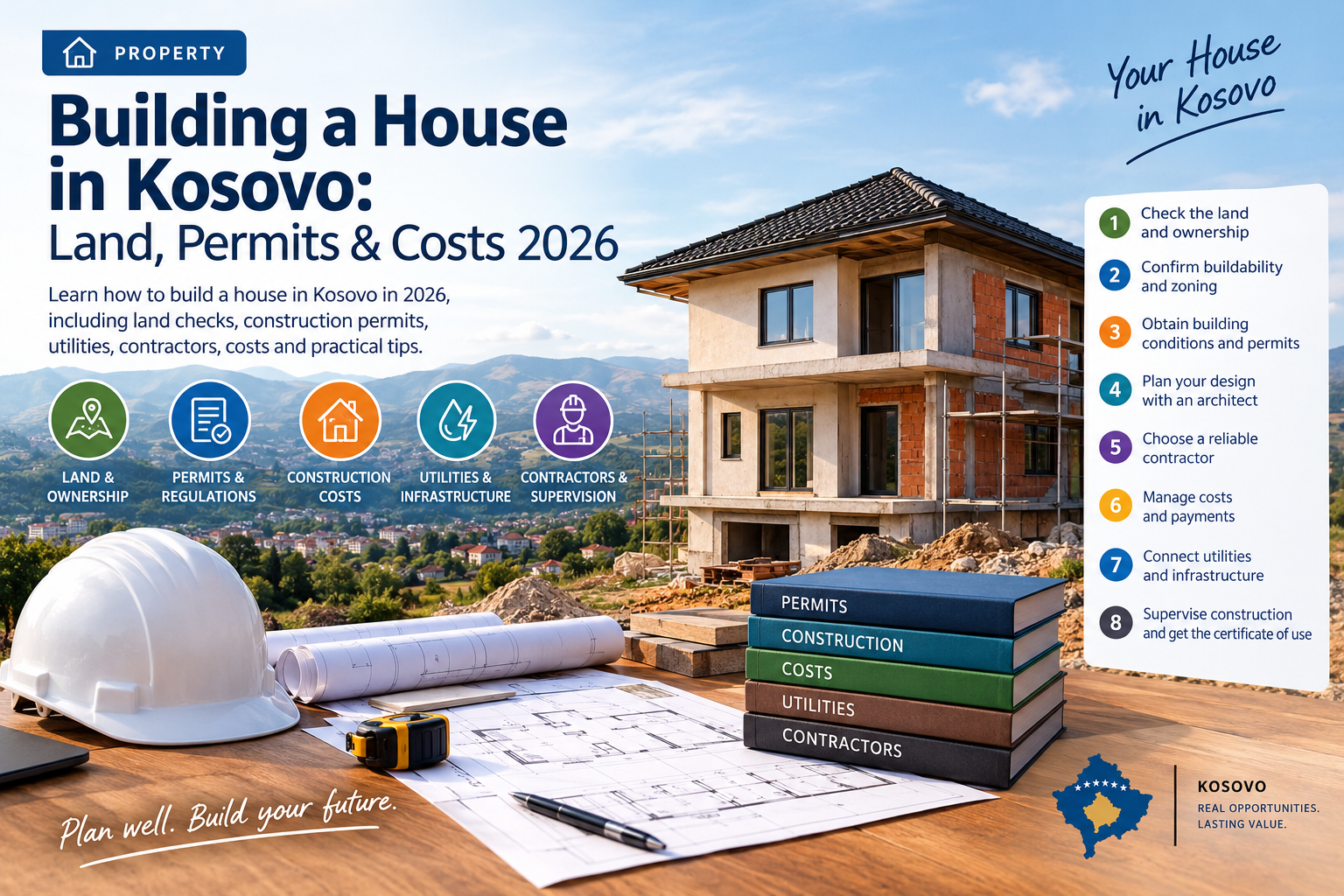
Building your own house in Kosovo can offer more freedom than buying an existing apartment or house.
You can choose the location, layout, materials, insulation standard, heating system and long-term design of the property.
But building a house also comes with more legal and financial risk.
The most important mistake to avoid is buying land first and only later asking whether you are allowed to build on it.
Kosovo’s Construction Law requires a construction permit for new construction, while municipalities issue building conditions and permits according to applicable spatial-planning documents. Gazeta Zyrtare
This 2026 guide explains what to check before buying land, how construction permits work, what documents may be required, how to choose a contractor, what determines construction costs and how to reduce the risk of expensive mistakes.
Can You Build a House Anywhere in Kosovo?
No.
Owning land does not automatically give you the right to build whatever you want on it.
Whether construction is possible depends on factors such as:
- Municipal spatial plans
- Zoning
- Building conditions
- Parcel size
- Access road
- Infrastructure
- Protected areas
- Agricultural-land restrictions
- Maximum permitted building footprint
- Height and distance rules
The municipality’s urbanism department is generally responsible for issuing building conditions and construction permits according to valid planning documents. Pristina, for example, states that its Urbanism Sector issues building conditions, construction permits and related planning approvals. Komuna Prishtina
First Rule: Check Buildability Before Buying the Land
Before paying a deposit, confirm whether the parcel can legally support the house you want to build.
Ask the municipality:
- Is this parcel inside a buildable zone?
- What type of building is permitted?
- What is the maximum building footprint?
- How many floors are allowed?
- What distance must be kept from parcel boundaries?
- Is road access legally recognized?
- Are utility connections available?
- Are there special planning restrictions?
Do not rely only on the seller saying:
“Everyone builds here.”
You need official confirmation.
Verify the Cadastral Parcel
Before buying land, verify:
- Parcel number
- Cadastral zone
- Registered owner
- Exact surface area
- Boundaries
- Co-owners
- Mortgages or other encumbrances
- Access rights
The physical fence on the land may not match the official cadastral boundary.
For a serious purchase, compare the cadastral documentation with the land on site.
Check for Co-Ownership
Co-ownership can create major delays.
If several family members or heirs own the parcel, one person may not have the legal right to sell or authorize construction alone.
Before paying:
- Identify every registered owner.
- Confirm whether all required signatures are available.
- Check for inheritance disputes.
- Check whether any ownership case is pending.
Land with unclear ownership can turn a simple house project into a legal problem.
Legal Road Access
A building plot should have clear legal access.
Do not assume that because you can physically drive across another person’s land, you have a permanent legal right to do so.
Verify whether the road is:
- Public
- Registered
- Part of the parcel
- Covered by a legal easement
Road access can affect both building approval and future property value.
Building Conditions
Before receiving a construction permit, you may need building conditions that define what can be built on the property.
These conditions can include:
- Building footprint
- Height
- Number of floors
- Position on parcel
- Distance from road
- Distance from neighbors
- Parking
- Infrastructure requirements
Pristina publishes building-condition decisions and permit information through its Urbanism Directorate. Komuna Prishtina
Other municipalities use their own local procedures within the national legal framework.
Do You Need a Construction Permit?
For a normal new house, yes.
Kosovo’s Construction Law states that a construction permit is required for:
- New construction
- Reconstruction
- Demolition
- Certain major repairs
- Certain interventions to façades and structures Gazeta Zyrtare
There are some limited types of minor works that may not require a permit, but these exemptions should not be confused with building a new house. Kosovo has a specific administrative instruction covering works that do not require construction permits. MMPHI
Construction Categories
Kosovo’s Construction Law classifies construction projects into categories.
The law refers to:
- Category I – lower-risk construction
- Category II
- Category III – more complex construction Gazeta Zyrtare
A normal private house may fall within a lower category depending on the project, but classification should be confirmed by the architect and competent authority.
Do not choose permit requirements yourself.
Who Issues the Construction Permit?
For most ordinary residential projects, the municipality is the key authority.
The responsible urbanism or construction department reviews:
- Building conditions
- Project documentation
- Compliance with spatial plans
- Construction-permit application
In Pristina, the municipal Urbanism Sector explicitly states that it is responsible for issuing building conditions and construction permits. Komuna Prishtina
Hire an Architect Early
A good architect should be involved before construction starts.
The architect can help with:
- Site evaluation
- Design
- Building conditions
- Permit documentation
- Space planning
- Energy efficiency
- Structural coordination
- Utility planning
- Contractor drawings
Hiring the architect only after buying unsuitable land can be too late.
What Should the Architectural Project Include?
Depending on the project and permit category, documentation may include:
- Site plan
- Floor plans
- Elevations
- Sections
- Structural design
- Electrical design
- Plumbing design
- Heating and ventilation
- Energy-performance elements
- Fire-safety requirements
- Utility connections
The Construction Law states that construction documentation is governed by the applicable construction framework and standards. Gazeta Zyrtare
Do Not Build Before the Permit Is Issued
Starting construction without approval can create serious problems.
Possible consequences may include:
- Inspection
- Stop-work orders
- Fines
- Legalization difficulties
- Problems selling the property
- Problems connecting utilities
- Problems obtaining financing
Always confirm that the permit has actually been issued.
Pristina even publishes annual lists of issued permits and notes that a project not appearing in its records may either not have a permit or still be in the permit process. Komuna Prishtina
How Long Is a Construction Permit Valid?
Permit conditions can include deadlines for starting work.
Official permit templates under Kosovo’s construction procedures state that the permit holder may be required to begin construction within one year from issuance. Gazeta Zyrtare
Always check the exact conditions written on your permit.
Construction Permit Fees
Permit costs depend on:
- Municipality
- Building size
- Project category
- Infrastructure fees
- Applicable municipal tariffs
Kosovo also has administrative rules covering construction-permit fees and infrastructure-regulation tariffs. Gazeta Zyrtare
Do not use someone else’s old permit fee as your budget.
Ask the municipality for a current calculation based on your specific project.
Infrastructure Fees
In addition to the construction permit itself, municipalities may charge fees connected to infrastructure or urban density.
Pristina, for example, publishes standard forms for construction-tax and infrastructure-density payments. Komuna Prishtina
This can be a significant cost for some plots.
Always ask:
- Construction permit fee
- Infrastructure fee
- Connection fees
- Any municipal development charge
before buying the land.
How Much Does It Cost to Build a House in Kosovo?
There is no single reliable national price per square meter.
The real cost depends on:
- Location
- House size
- Number of floors
- Ground conditions
- Structural system
- Roof type
- Insulation
- Windows
- Heating
- Bathrooms
- Kitchen
- Interior finish
- Labor
- Contractor margin
A simple 120 m² house and a luxury 120 m² house can have dramatically different budgets.
Instead of asking only:
“How much per square meter?”
ask:
“What exactly is included in that price?”
Structure vs Turnkey Construction
Builders may quote different levels of completion.
Shell / structural stage
May include:
- Excavation
- Foundations
- Concrete structure
- Walls
- Roof
Closed shell
May add:
- Windows
- Exterior doors
- Roof completion
- Some façade work
Turnkey
May include:
- Electrical
- Plumbing
- Heating
- Flooring
- Painting
- Bathrooms
- Interior doors
But the meaning of “turnkey” varies.
Always define it in writing.
Create a Detailed Bill of Quantities
One of the best ways to control costs is to prepare a detailed Bill of Quantities, often called a BoQ.
It should specify:
- Materials
- Quantities
- Unit prices
- Labor
- Total cost
This makes contractor bids easier to compare.
Without a BoQ, one contractor may quote cheap materials while another includes better specifications.
The numbers may look similar but the projects are not equivalent.
Ground Conditions Matter
Foundation cost depends heavily on soil.
Before construction, the designer may recommend geotechnical investigation.
Difficult soil can increase:
- Excavation
- Concrete
- Reinforcement
- Drainage
- Retaining walls
A cheap plot on unstable or waterlogged ground can become an expensive project.
Check Drainage Before Buying Land
Visit the land after heavy rain if possible.
Look for:
- Standing water
- Mud
- Flooding
- Nearby drainage channels
- Water entering from higher land
Poor drainage can create problems for:
- Foundations
- Basement
- Garden
- Access road
This is particularly important if you plan a basement.
Building on a Slope
Sloped land can offer excellent views, but costs can rise.
Potential extra costs include:
- Excavation
- Retaining walls
- Drainage
- More complex foundations
- Stepped access
- Landscaping
A flat parcel may be financially easier even if its purchase price is higher.
Electricity Connection
Before buying land, find out how far the nearest electricity connection is.
Ask:
- Is there an existing grid connection nearby?
- What connection capacity is available?
- Who pays for extension work?
- How far is the transformer?
A distant utility connection can add unexpected cost.
Link this section to your Electricity in Kosovo guide.
Water Connection
Check whether the property can connect to:
- Municipal water network
- Private well
- Alternative supply
For a public connection, ask:
- Where is the nearest water line?
- Is sufficient pressure available?
- What is the connection fee?
If relying on a well, investigate water availability before construction.
Link this section to your Water in Kosovo guide.
Sewerage
Do not assume every plot has sewer access.
Ask:
- Is a public sewer available?
- Where is the nearest connection?
- Is connection mandatory?
In areas without public sewerage, a septic system may be required.
Its design, location and maintenance should be planned properly.
Internet and Telecom Infrastructure
For many homeowners, internet is now basic infrastructure.
Before buying remote or rural land, check:
- Fiber availability
- Fixed broadband
- Mobile signal
- Provider coverage
A beautiful rural site may have weaker telecom infrastructure than expected.
Heating System
Choose the heating system early.
Possible options include:
- Heat pump
- Air conditioning
- Electric heating
- Pellet heating
- Wood heating
- Central boiler
- Underfloor heating
The system affects both:
- Construction design
- Long-term operating cost
Changing heating strategy after floors and walls are finished can be expensive.
Insulation Is Worth Prioritizing
Good insulation can reduce long-term energy costs.
Pay attention to:
- Exterior walls
- Roof
- Floor insulation
- Windows
- Thermal bridges
- Air sealing
Spending slightly more during construction can reduce heating and cooling expenses for decades.
Windows
Window quality affects:
- Heat loss
- Noise
- Condensation
- Comfort
- Energy use
Compare:
- Frame quality
- Double vs triple glazing
- Installation method
- Warranty
A good window installed badly can still perform poorly.
Roof
Roof design affects:
- Cost
- Maintenance
- Insulation
- Water drainage
- Attic space
Choose materials suitable for local climate and contractor experience.
Poor waterproofing can cause very expensive damage later.
Construction Contract
Never rely only on a verbal agreement with the builder.
The contract should specify:
- Total price
- Scope of work
- Materials
- Start date
- Completion date
- Payment schedule
- Penalties
- Warranty
- Responsibility for defects
- Who purchases materials
The more specific the contract, the less room there is for dispute.
Do Not Pay Everything Upfront
Payments should usually be linked to construction stages.
For example:
- Deposit
- Foundation completion
- Structural frame
- Roof
- Mechanical/electrical
- Finishes
- Final completion
Avoid paying the entire project cost at the beginning.
Keep financial leverage until work is completed properly.
Verify the Contractor
Before hiring a builder:
- Visit completed houses.
- Speak with previous clients.
- Verify business registration.
- Ask about delays.
- Ask about warranty claims.
- Review previous contracts.
A cheap quote means very little if the contractor abandons the project.
Ask for Multiple Quotes
Get at least three comparable quotations.
Provide every contractor with the same:
- Drawings
- Specifications
- BoQ
Then compare:
- Price
- Materials
- Schedule
- Payment terms
- Experience
Otherwise you are comparing different projects.
Keep the Architect or Engineer Involved
Do not let the contractor make every technical decision alone.
Independent supervision can help identify:
- Incorrect reinforcement
- Poor concrete work
- Waterproofing problems
- Insulation gaps
- Deviations from drawings
Fixing errors while construction is open is much cheaper than after finishing.
Construction Supervision
Depending on the project, professional supervision may be required or strongly advisable.
The designer may also monitor whether construction follows the approved documentation; Kosovo’s Construction Law recognizes designer monitoring of the construction process. Gazeta Zyrtare
For a major personal investment, independent technical oversight is worth considering even when not strictly mandatory.
Keep Photographic Records
Take photos during construction.
Especially before covering:
- Plumbing
- Electrical cables
- Underfloor heating
- Waterproofing
- Reinforcement
- Drainage
These records are extremely useful later if repairs are needed.
Changes During Construction
Owners frequently change their minds.
Examples:
- Larger windows
- Extra bathroom
- Different staircase
- Additional room
Every change can affect:
- Structure
- Cost
- Permit compliance
- Electrical design
- Plumbing
Discuss changes with the architect before letting the contractor improvise.
Avoid Constant Design Changes
Late changes are expensive.
Moving a wall on paper is easy.
Moving it after plumbing and flooring have been installed is not.
Spend enough time finalizing the design before construction starts.
Budget for Contingencies
Never use 100% of your money on the quoted construction price.
Unexpected expenses can include:
- Soil issues
- Material-price changes
- Utility connections
- Design changes
- Extra drainage
- Landscaping
- Permit costs
Keeping a contingency reserve is important.
The House Is More Than the Building
People often budget only for construction.
But you may also need:
- Land
- Notary/legal costs
- Architect
- Engineering
- Permit
- Infrastructure fees
- Electricity connection
- Water connection
- Fence
- Gate
- Garden
- Driveway
- Kitchen
- Furniture
These can represent a large additional cost.
Landscaping
Landscaping is often postponed until the end.
Plan early for:
- Rainwater
- Drainage
- Driveway
- Parking
- Garden level
- Retaining walls
Poor landscaping can push water toward the house.
Rainwater Management
Your design should safely direct water away from the foundation.
Consider:
- Gutters
- Downpipes
- Surface slope
- Drainage
- Soakaways where appropriate
Water is one of the biggest long-term threats to buildings.
Basement or No Basement?
Basements provide useful space but increase complexity.
They require:
- Excavation
- Waterproofing
- Drainage
- Retaining structure
- Ventilation
If you do not truly need a basement, compare the cost with building above ground instead.
One Storey or Two?
A single-storey house can be convenient, but requires more land for the same living area.
A two-storey house:
- Uses less footprint
- Can provide better separation of rooms
but adds:
- Stairs
- Structural complexity
- Accessibility considerations
Choose based on lifestyle, not only appearance.
Think About Future Needs
A house may be used for decades.
Consider:
- Children
- Older parents
- Working from home
- Accessibility
- Storage
- Parking
- Solar panels
- EV charger
Planning infrastructure now can be cheaper than modifying it later.
Solar Preparation
Even if you do not install solar immediately, you can design the roof for future panels.
Consider:
- Orientation
- Shading
- Roof structure
- Electrical conduit
Preparing during construction is relatively inexpensive.
Buying Land in a Village
Rural land can offer:
- More space
- Lower prices
- Privacy
But check:
- Road quality
- Water
- Electricity
- Sewer
- Internet
- Winter access
Do not assume infrastructure will arrive soon.
Building Near Pristina
Land near Pristina can be attractive because of:
- Employment
- Schools
- Services
- Property demand
But development pressure can also mean:
- Higher land prices
- Traffic
- More complex planning
- Higher infrastructure charges
Check the exact municipal plan before investing.
Construction Permit Transparency
Some municipalities publish building permits publicly.
Pristina provides annual lists of issued construction permits, including 2026 permits. Komuna Prishtina
This can be useful when:
- Verifying a developer
- Checking neighboring construction
- Confirming permit status
Buying a House Under Construction
If buying from a developer rather than building yourself, ask to see:
- Construction permit
- Land ownership
- Approved project
- Developer registration
- Completion schedule
Do not rely only on marketing materials.
Certificate of Use
Construction does not necessarily end when the builder leaves.
The Construction Law also regulates the issuance of a certificate of use as part of the legal construction framework. Gazeta Zyrtare
Depending on the project category and requirements, final approvals may be needed before the building is legally considered complete for use.
Ask the architect what applies to your house.
Before You Buy Land Checklist
Before paying:
Legal
- Verify owner.
- Check cadastral parcel.
- Check mortgages.
- Check co-ownership.
Planning
- Confirm buildability.
- Confirm building conditions.
- Confirm maximum floors and footprint.
Infrastructure
- Check road.
- Check electricity.
- Check water.
- Check sewer.
- Check internet.
Physical
- Check slope.
- Check soil.
- Check drainage.
- Check flood risk.
Financial
- Estimate permit fees.
- Estimate utility connections.
- Estimate construction.
- Keep contingency.
If one important answer is unclear, investigate before signing.
Construction Checklist
Before starting:
- Land ownership complete
- Building conditions issued
- Architect selected
- Project complete
- Construction permit issued
- Contractor contract signed
- BoQ agreed
- Payment schedule agreed
- Site supervision arranged
- Utility plan confirmed
Do not begin with only drawings and a contractor.
Common Mistakes
Avoid:
- Buying land without checking zoning
- Building before the permit
- Using only verbal agreements
- Paying contractor upfront
- Comparing quotes without specifications
- Ignoring drainage
- Underestimating utility connections
- Changing design constantly
- Buying cheapest materials everywhere
- Spending the full budget before completion
Is Building a House in Kosovo Worth It?
It can be.
Building gives you more control over:
- Layout
- Energy efficiency
- Materials
- Location
- Quality
But it requires more time and management than buying an existing property.
The project works best when you:
verify the land → design carefully → obtain permits → compare contractors → supervise construction → control the budget.
Final Thoughts
Building a house in Kosovo can be a very rewarding project, but the land and legal process matter just as much as the construction itself.
Kosovo’s Construction Law requires permits for new construction and establishes the legal framework for building permits and certificates of use. Municipal urbanism departments then apply spatial-planning rules and issue the relevant local approvals. Gazeta Zyrtare
The safest sequence is:
check the parcel → confirm buildability → obtain building conditions → design the house → obtain the permit → hire the contractor → begin construction.
If you reverse that order, mistakes become expensive very quickly.