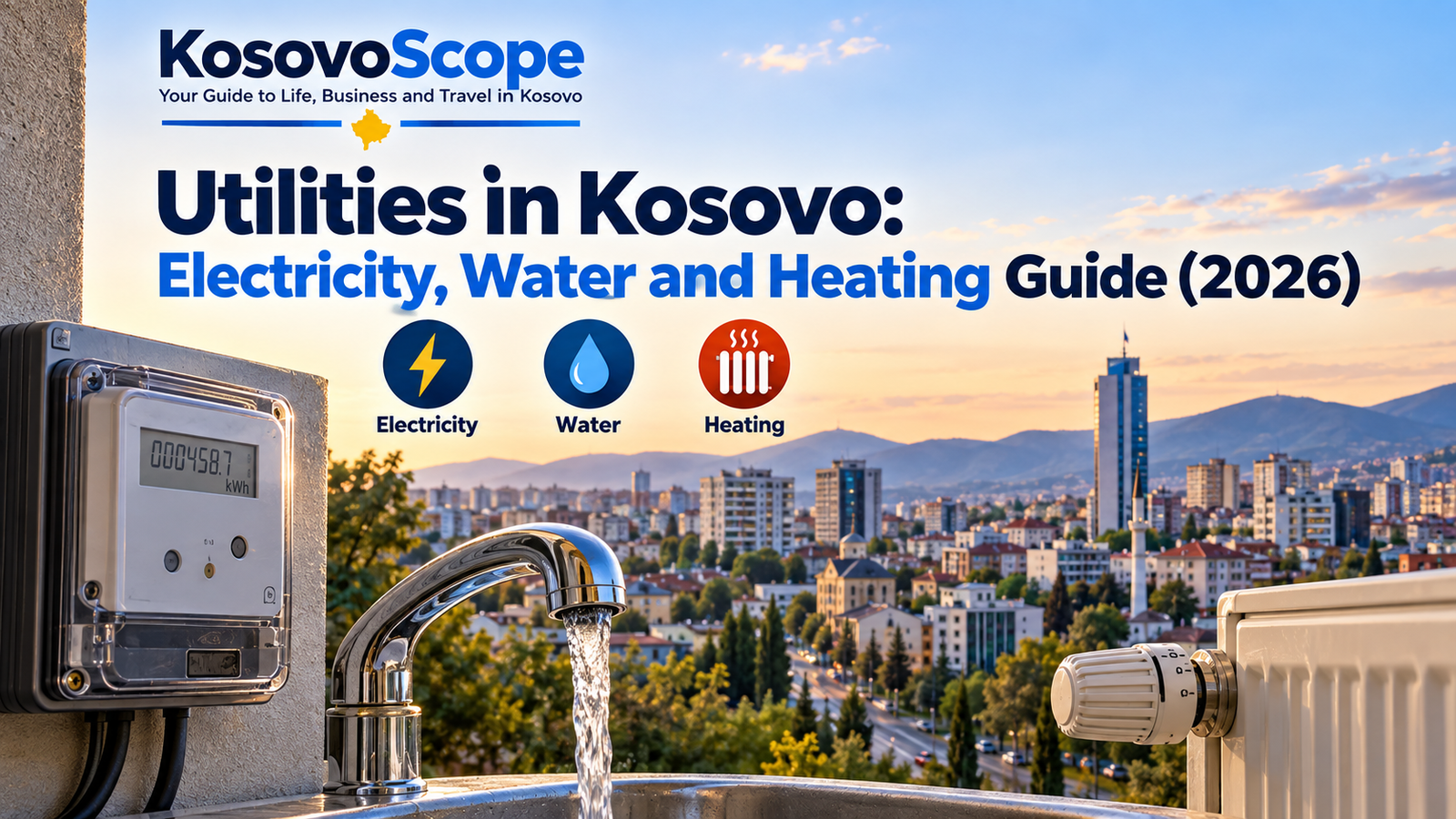
Understanding utilities in Kosovo is an important part of moving, renting or buying property in the country.
Electricity, water and heating systems are generally straightforward once you understand which company is responsible for each service. However, the structure can be confusing for newcomers because electricity distribution and electricity supply are handled by different companies, water providers vary by region, and district heating is available only in certain locations.
This guide explains how electricity, water and heating utilities work in Kosovo in 2026, how bills are typically managed, what renters and property owners should check, and which official providers to contact when problems occur.
How Utilities Work in Kosovo
Utilities in Kosovo are provided through a combination of national, regional and municipal companies.
Electricity distribution is managed by KEDS, while KESCO handles electricity supply and customer accounts for regulated customers. Water services are organised through regional water companies, meaning the provider depends on where you live.
Heating arrangements vary significantly between properties. Some buildings in Prishtina are connected to the Termokos district heating network, while many other homes rely on electric heating, heat pumps, wood, pellets or individual heating systems.
For this reason, it is important to ask exactly which utilities are included before renting or buying a property.
Electricity in Kosovo
Electricity is one of the most important household utilities, especially because many homes also use electricity for heating, hot water and cooking.
KEDS vs KESCO: What Is the Difference?
The distinction between KEDS and KESCO is one of the first things newcomers should understand.
KEDS operates the electricity distribution network. It deals with network connections, distribution infrastructure, faults and technical issues.
KESCO is responsible for electricity supply, customer accounts, billing and supply contracts for its customers.
According to KESCO’s official new-customer guidance, a new customer must first obtain approval for connection to the distribution network through KEDS. After the connection agreement has been approved, the customer submits it to KESCO, where the customer account is opened and an electricity supply contract is signed. Kesco Energy
A simple way to remember it is:
KEDS = electricity network
KESCO = electricity supplier and billing
Setting Up Electricity in a New Property
If you move into an apartment that already has an active electricity connection, the process may simply involve confirming whose name the customer account is registered under.
For a newly constructed property or a property without an existing connection, the process can be more involved.
The technical connection is handled through KEDS. Once the technical requirements and connection agreement are completed, the customer can proceed with KESCO to open the electricity account and sign the supply contract. Kesco Energy
If you are renting, ask your landlord whether:
- the electricity account remains in the landlord’s name;
- the tenant is expected to transfer the account;
- there are any unpaid previous bills;
- the electricity meter serves only your apartment.
Never assume these details without checking.
Electricity Bills
Electricity bills normally depend on actual consumption.
Households using electricity for heating may see significantly higher winter consumption than homes connected to district heating or using another heating source.
Before moving into a property, it can be useful to ask the landlord or previous owner for examples of previous winter and summer bills.
KESCO also operates the eKesco service, which provides access to electricity bills, payment information, historical consumption and planned maintenance information. Kesco Energy
This can be particularly useful for residents who want to monitor their monthly consumption.
Electricity Prices in 2026
Electricity tariffs in Kosovo are regulated by the Energy Regulatory Office.
In May 2026, the regulator announced that the structure of regulated retail electricity tariffs remained unchanged and that there was no tariff increase for the relevant 2026 tariff year. Ero-KS
Actual household bills still vary considerably depending on consumption, home size, insulation, heating method and appliances.
For that reason, it is better to estimate your likely bill based on the specific property rather than relying on a single nationwide monthly average.
Power Cuts and Electricity Problems
Power interruptions can occur because of maintenance, local faults or network problems.
For issues related to the electricity network, KEDS provides a toll-free customer line at 0800 791 00 and states that its communication channels are available throughout Kosovo.
KEDS also provides the emergency number #1999, but this line is intended only for serious emergencies such as fire, accidents or life-threatening electrical hazards. Keds Energy
For ordinary billing or customer-account questions, you should contact KESCO rather than the emergency network line.
Water Supply in Kosovo
Water services in Kosovo are organised regionally.
Unlike electricity, there is no single company that handles every household water account throughout the country.
Your water provider will therefore depend on the municipality or region where you live.
In cities and larger residential areas, water bills are generally associated with the regional water utility serving that area.
When renting an apartment, ask:
- which regional water company serves the property;
- whether the apartment has an individual meter;
- whether water charges are billed separately;
- whether the landlord or tenant pays the bill;
- whether there are any outstanding charges.
This is especially important in apartment buildings where water arrangements may differ between older and newer properties.
Water Meters and Billing
Many properties have metered water consumption, but the exact billing arrangement can vary by building.
A useful precaution when moving into a new property is to photograph the meter reading on the day you receive the keys.
The same principle applies when leaving the property.
This creates a clear record of your actual consumption period and reduces the risk of disputes over earlier bills.
If you are buying property, ask the seller for confirmation that utility accounts are fully paid before the transaction is completed.
Water Interruptions
Temporary water interruptions may occur because of infrastructure work, repairs or local supply issues.
Regional water providers normally publish service notices through their official websites or social media channels.
If uninterrupted water supply is particularly important to you, for example because you work from home or have specific household requirements, ask neighbours or the property owner about the reliability of supply in that particular area.
Heating in Kosovo
Heating is one of the most important considerations when choosing housing in Kosovo.
Winters can be cold, and the heating method can have a major impact on both comfort and monthly household costs.
Common heating systems include:
- district heating;
- electric radiators;
- air-conditioning or heat-pump systems;
- electric boilers;
- wood-burning systems;
- pellet heating;
- private central-heating systems.
Always ask how a property is heated before signing a lease.
District Heating in Prishtina
Some areas of Prishtina are connected to the Termokos district heating system.
Termokos describes itself as the local district heating supplier for Prishtina. The standard heating season runs from October 15 to April 15, although it can be extended or shortened depending on weather conditions. Termokos
Termokos states that since the cogeneration system began operating, heating supply for consumers runs continuously throughout the heating season. Termokos
Which Areas Does Termokos Serve?
According to Termokos, its network serves several parts of Prishtina, including areas such as:
- Qendra;
- Ulpiana;
- Dardania;
- Kalabria;
- Kodra e Diellit;
- Mati 1;
- Arbëria.
Coverage can depend on the specific building, so never assume an apartment is connected simply because it is located in one of these neighbourhoods. Termokos
Ask the landlord or seller to confirm the connection.
What Does Termokos Cover?
Termokos is responsible for the primary district heating network up to the heat exchangers in substations.
The company explains that secondary heating infrastructure inside buildings — such as circulation pumps, vertical pipes and apartment radiators — is generally on the consumer or building side. Termokos
This distinction matters if your apartment is cold despite the wider network operating normally.
The problem may be inside the building rather than in the Termokos network.
Does Termokos Provide Hot Water?
No.
Termokos states that its system currently provides space heating only and does not supply domestic hot water.
Many households therefore use individual electric water heaters for showers and household hot water. Termokos
This is an important detail because even a home connected to district heating may still use electricity for hot water.
Electric Heating
Many apartments and houses in Kosovo rely partly or entirely on electricity for heating.
Electric heaters are simple to use but can lead to higher consumption during winter.
Modern heat pumps and inverter air-conditioning systems can be more efficient than basic electric resistance heaters, although performance depends on the building and equipment.
When viewing an apartment, ask whether the property has:
- inverter air conditioning;
- panel heaters;
- electric underfloor heating;
- an electric boiler;
- another heating system.
Also check insulation and window quality.
A well-insulated apartment can make a substantial difference to winter energy consumption.
Wood and Pellet Heating
Wood and pellet systems are still used in many houses and some apartments outside district-heating areas.
These systems can provide strong heating but also require storage, maintenance and regular fuel supply.
If you are unfamiliar with wood or pellet heating, ask the landlord or owner about:
- annual fuel requirements;
- where fuel is stored;
- chimney maintenance;
- who services the heating system;
- whether heating costs are included in the rent.
Typical Utility Costs in Kosovo
There is no single reliable monthly utility figure that applies to every household.
Costs depend heavily on:
- city;
- size of the property;
- number of occupants;
- heating method;
- insulation;
- season;
- electricity use;
- water consumption.
Winter can be considerably more expensive for households using electricity as their main heating source.
For realistic budgeting, ask for actual past bills for the specific apartment you are considering.
This is generally more useful than comparing broad online averages.
Utilities for Renters
Before signing a rental agreement, confirm exactly which utilities are included in the rent.
Ask the landlord:
Who pays each bill?
Some landlords include certain services in the monthly rent, while others require tenants to pay everything separately.
Whose name is on the account?
The electricity, water or heating account may remain in the landlord’s name.
This is not necessarily a problem, but you should understand how payment will work.
Are there unpaid bills?
Ask for confirmation that previous bills have been cleared.
How is the home heated?
Do not wait until winter to discover that an apartment uses an expensive or inadequate heating system.
What were previous winter bills?
This can provide one of the best indications of realistic household costs.
Utilities for Property Buyers
Utility checks are also important when buying property.
Before completing a purchase, verify:
- electricity connection status;
- electricity meter;
- water connection and meter;
- district-heating connection if applicable;
- unpaid utility balances;
- condition of the heating system.
For newer properties, you should also confirm whether all permanent utility connections have been completed.
A newly built apartment may look finished while certain infrastructure or account-registration procedures are still being finalised.
Paying Utility Bills
Utility payments can normally be made through a range of channels depending on the provider.
These may include:
- banks;
- online banking;
- provider apps;
- payment offices;
- post offices;
- authorised payment institutions.
Termokos, for example, lists its own payment offices, Kosovo banks, the Kosovo Post and certain financial institutions among its payment options. Termokos
KESCO’s digital platform also allows consumers to access billing and payment information electronically. Kesco Energy
Moving Into a New Apartment: Utility Checklist
When you receive the keys to a new home, take a few minutes to document everything.
Record or photograph:
- electricity meter reading;
- water meter reading;
- heating meter if present;
- account numbers;
- existing unpaid balances;
- condition of radiators or heating equipment.
Also save the relevant provider contact details.
This can prevent confusion months later.
Common Utility Problems
High Electricity Bills
Check whether electric heating, water heaters or older appliances are consuming more electricity than expected.
Apartment Is Cold Despite District Heating
The problem may involve the building’s secondary heating system or apartment radiators rather than Termokos’s primary network.
No Hot Water
Remember that district heating does not automatically mean domestic hot water is included.
Water Bill Seems Too High
Compare the current meter reading with the previous bill and check for leaks.
Previous Tenant Left Debt
Contact the provider or landlord before paying anything you do not recognise.
Practical Tips for Expats
If you are new to Kosovo, these habits can make utility management much easier:
Keep digital copies of your bills.
Take meter photographs when moving in and out.
Use provider apps where available.
Keep your landlord informed about technical problems.
Never use emergency numbers for ordinary customer-service questions.
Ask neighbours about building-specific issues.
Check heating before signing a lease during summer.
Frequently Asked Questions
Who supplies electricity in Kosovo?
KEDS manages the electricity distribution network, while KESCO supplies electricity and manages customer accounts for its customers. Keds Energy
Can I view my electricity bill online?
Yes. KESCO provides the eKesco platform, which allows customers to access bills, payment information and consumption data. Kesco Energy
Is district heating available everywhere in Kosovo?
No. District heating is available only in certain areas and cities. In Prishtina, Termokos supplies specific neighbourhoods and buildings.
When does heating season start in Prishtina?
Termokos states that the standard heating season begins on October 15 and ends on April 15, although weather conditions can affect the exact operating period. Termokos
Does Termokos provide hot water?
No. Termokos currently provides space heating rather than domestic hot water. Termokos
Are electricity prices increasing in 2026?
The Energy Regulatory Office stated in May 2026 that regulated retail tariff structures remained unchanged and there was no increase for the relevant 2026 tariff year. Ero-KS
Should renters check utility debts before moving in?
Yes. It is sensible to confirm account status, meter readings and any outstanding balances before taking responsibility for a property.
Conclusion
Understanding utilities in Kosovo becomes much easier once you know which organisation handles each service.
KEDS manages the electricity network, KESCO manages supply and customer accounts, water services are handled regionally, and district heating is available only in certain locations.
For renters and property buyers, the most important step is to inspect the specific property rather than relying on general assumptions.
Ask how the home is heated, check the meters, confirm who pays each bill and request previous winter utility costs whenever possible.
A little preparation before moving in can prevent unexpected bills and make everyday life in Kosovo much easier.