What are people in Kosovo like? For many visitors, one of the most memorable aspects of Kosovo is not just its mountains, historic towns or lively cafés, but the warmth of everyday human interactions.
Kosovo is often associated with hospitality, close family relationships, a strong coffee culture and a tradition of welcoming guests. Visitors may find themselves invited for coffee, offered homemade food or helped by someone they have only just met.
These experiences are part of the country’s social appeal. However, Kosovo is also a diverse society, and no single description can capture the personalities, experiences or beliefs of every person living there.
Kosovo is home to ethnic Albanians, Serbs, Bosniaks, Turks, Roma, Ashkali, Egyptians, Gorani and other communities. Its religious landscape includes Muslims, Orthodox Christians, Catholics, people of other faiths and people who do not identify with a religion.
This 2026 guide explores the people of Kosovo, their hospitality, everyday culture, family traditions, ethnic diversity, religious communities, languages and what international visitors can expect when interacting with local residents.
1. What Are People in Kosovo Like?
People in Kosovo are often described by visitors through their experiences of friendly conversations, generous hospitality and a lively social atmosphere.
In many communities, sharing coffee, offering food and welcoming guests are meaningful parts of social life.
Family ties, friendships and community relationships can also play an important role.
In Kosovo’s towns and cities, cafés are popular places for meeting friends, discussing everyday matters and spending time together.
However, these are cultural observations rather than characteristics shared by every individual.
Someone’s personality, openness or willingness to socialize depends on the person and circumstances, not simply their nationality or ethnic background.
The best way to understand Kosovo’s people is through direct, respectful interaction.
2. Are People in Kosovo Friendly to Foreigners?
Many visitors and foreign residents describe positive experiences with local hospitality.
In practical situations, friendliness may take the form of someone helping with directions, recommending a restaurant or taking time to explain something.
In tourist areas, cafés and businesses, travelers may encounter people willing to communicate in English or another language they know.
Kosovo also has extensive family and diaspora connections with countries such as Germany, Switzerland and Austria.
These connections form part of the country’s international social environment.
Nevertheless, language barriers and cultural misunderstandings can occur, just as they can anywhere.
Visitors should approach individuals respectfully rather than assuming every stranger will be equally outgoing.
3. Hospitality in Kosovo: The Tradition of Welcoming Guests
Hospitality is an important theme in Kosovo’s cultural identity.
The Albanian concept of mikpritja refers to welcoming and treating guests with care and respect.
Visitors may encounter hospitality through small gestures:
- Offering coffee or tea.
- Sharing a meal.
- Inviting guests to sit and talk.
- Helping visitors find their way.
- Introducing guests to friends or family.
- Making an effort to communicate despite language differences.
The importance of hospitality also appears in traditional Albanian cultural ideas surrounding the treatment of guests and personal honor.
The concept of besa, associated with keeping one’s word and trust, is often discussed in this broader cultural context.
However, hospitality should not be romanticized as an obligation placed on every household or individual.
The practical expression of these traditions differs between families, communities, generations and personal circumstances.
4. Why Is Coffee So Important in Kosovo?
Coffee plays an important social role in many parts of Kosovo.
A café is often more than somewhere to purchase a drink. It can be a place for conversation, friendship, business meetings or a short break during the day.
Prishtina is particularly known for its lively café scene, but coffee culture is visible in many towns across the country.
Visitors may encounter espresso, macchiato and traditional coffee preparations.
Meeting someone for coffee can be a simple, informal way of building a connection.
For travelers, sitting in a local café is also an opportunity to observe daily life without needing a formal sightseeing activity.
5. Family and Community Life in Kosovo
Family relationships are significant in many Kosovo households.
Relatives may maintain regular contact, gather for meals and celebrate important occasions together.
Weddings, birthdays, religious holidays and family visits can bring extended relatives together.
Respect for older family members is also an important value in many households, although family structures and expectations vary widely.
At the same time, Kosovo is experiencing social and economic changes.
Urbanization, international migration, education and modern employment patterns influence how families live.
Younger adults may have different expectations about independence, marriage, work and lifestyle than previous generations.
It is therefore inaccurate to suggest that every Kosovo family follows one traditional model.
6. Kosovo’s Population and Ethnic Diversity
Kosovo is a multiethnic country.
The Kosovo Agency of Statistics reported an estimated resident population of 1,602,515 in its 2024 census results, published in December 2024.
The published ethnic composition, including estimates for the four northern municipalities with low census participation, was approximately:
| Ethnic community | Share |
|---|---|
| Albanian | 90.79% |
| Serb | 3.31% |
| Bosniak | 1.69% |
| Turk | 1.21% |
| Ashkali | 1.01% |
| Egyptian | 0.66% |
| Gorani | 0.57% |
| Roma | 0.54% |
| Other | 0.14% |
A small additional share preferred not to answer.
Source: Kosovo Agency of Statistics, 2024 Population and Housing Census, first final results.
These percentages reflect the officially reported population estimates. They should not be confused with tables counting only people directly enumerated during the census.
Participation was particularly low in four northern municipalities, where the statistical agency used population estimates. Consequently, some publications show different ethnic percentages depending on which population base they use.
The figures describe demographic composition. They do not determine how any individual identifies culturally or personally.
7. Kosovo Albanians
The cultural identity of people in Kosovo is shaped by both shared traditions and individual experiences. Among Kosovo Albanians, hospitality, family celebrations and social relationships remain visible aspects of cultural life.
Ethnic Albanians form Kosovo’s largest population group.
Albanian language and cultural traditions are prominent in many aspects of everyday life, particularly in Albanian-majority municipalities.
Food, music, family celebrations, regional customs and hospitality are important elements of cultural expression.
However, Kosovo Albanians are not a culturally uniform group.
People differ in religious identification, political views, lifestyle, social practices and personal values.
Some strongly emphasize traditional customs, while others identify more closely with contemporary urban lifestyles.
Many combine both.
8. Kosovo Serbs
The Kosovo Serb community forms an important part of the country’s cultural, linguistic and historical landscape.
Serbian is one of Kosovo’s two official languages.
Kosovo Serb communities maintain their own cultural institutions, traditions, religious heritage and community organizations.
Serbian Orthodox churches and monasteries are significant elements of Kosovo’s historical and religious landscape.
Relationships between communities have also been shaped by historical conflict, political disagreements and unresolved social issues.
It is important not to treat individual people as representatives of political positions.
Respectful interaction means recognizing each person’s identity without making assumptions based on ethnicity.
9. Bosniak, Turkish and Gorani Communities
Kosovo’s Bosniak, Turkish and Gorani communities contribute to its linguistic and cultural diversity.
Bosniaks maintain Bosnian language traditions and community identities, with notable communities in the Prizren region and elsewhere.
Kosovo Turks have a longstanding cultural presence, particularly visible in Prizren and other municipalities.
Turkish language, cultural associations, cuisine and traditions remain part of Kosovo’s social landscape.
Gorani communities are historically associated with the Gora region and maintain distinctive local traditions and linguistic identities.
Each community has its own history and internal diversity.
These identities should not be reduced to religious affiliation or treated as interchangeable.
10. Roma, Ashkali and Egyptian Communities
Roma, Ashkali and Egyptian communities are recognized as distinct communities in Kosovo.
Although they are sometimes discussed together in statistical or policy reports, they have different identities, histories and cultural experiences.
Their communities contribute to Kosovo’s cultural and social life.
At the same time, reports by civil-society and international organizations have documented challenges affecting members of some non-majority communities, including discrimination and unequal access to opportunities.
A balanced understanding of Kosovo must acknowledge both cultural diversity and the practical importance of equal rights.
Respectful descriptions should use the communities’ recognized names and avoid stereotypes.
11. What Religions Are Practiced in Kosovo?
Kosovo has a Muslim majority and longstanding Christian communities.
The 2024 census recorded the following religious distribution among 1,585,566 directly enumerated residents:
| Religious identification | Share |
|---|---|
| Islam | 93.49% |
| Orthodox Christianity | 2.31% |
| Catholic Christianity | 1.75% |
| Other religions | 0.45% |
| No religion | 0.50% |
| Preferred not to answer | 1.50% |
Source: Kosovo Agency of Statistics, 2024 Census, Table 3.6.
These figures are based on the directly enumerated population and do not incorporate the additional population estimates used in the nationwide total.
Religious identity does not necessarily describe the level of religious observance.
People may identify with a faith while practicing it in very different ways.
Others may participate in cultural traditions without identifying as particularly religious.
12. Islam and Muslim Traditions in Kosovo
Islam is the most widely reported religion in Kosovo.
Mosques are visible in towns and villages, and Muslim religious and cultural traditions have influenced parts of the country’s history and everyday life.
Ramadan and Eid celebrations are important occasions for many Muslim families.
Family meals, visits and charitable activities may play a role during religious holidays.
Nevertheless, the degree of religious observance varies.
Some people attend mosque regularly, some primarily participate in major holidays, and others live more secular lifestyles.
Visitors should avoid assuming that every Muslim in Kosovo follows identical religious practices.
13. Orthodox Christianity and Serbian Heritage
Orthodox Christianity has a longstanding presence in Kosovo.
Serbian Orthodox religious heritage includes historic churches and monasteries.
Some of these sites are also internationally recognized for their architectural and cultural significance.
Religious celebrations, including Orthodox Christmas and Easter, are important to many believers.
Visitors to religious sites should follow local guidance regarding appropriate clothing, photography and respectful behavior.
Religious heritage is an important part of Kosovo’s history, but religious identity should not be automatically equated with ethnic identity.
14. Catholic Christianity and Other Beliefs
Catholic communities also form part of Kosovo’s religious landscape.
Catholic churches, family traditions and Christmas celebrations are visible in several municipalities.
Prishtina’s Cathedral of Saint Mother Teresa is one of the city’s best-known Catholic landmarks.
Kosovo is also home to smaller religious communities and people who identify with no religion.
The country’s Constitution protects freedom of belief and religious expression.
A visitor may therefore encounter people who have very different religious views within the same neighborhood, workplace or social circle.
15. Do Different Religions Live Together in Kosovo?
Kosovo has a long history of different religious traditions existing within the same geographic space.
Mosques, Catholic churches and Orthodox churches are all part of the country’s cultural landscape.
Prizren is often noted for its visible religious and architectural heritage.
However, coexistence should not be portrayed as meaning that social or political tensions never occur.
Kosovo has experienced serious conflict and continues to face challenges relating to intercommunity relations and minority rights.
A responsible account recognizes both the value of cultural diversity and the need for continued protection of religious freedom and equal treatment.
For visitors, the most useful approach is to show respect toward all religious traditions without assuming an individual’s beliefs.
16. What Languages Do People Speak in Kosovo?
Kosovo’s two official languages are Albanian and Serbian.
The Constitution also provides for Turkish, Bosnian and Romani to have official or official-use status at the municipal level under applicable legislation.
Albanian is widely spoken across Albanian-majority areas.
Serbian is used by the Kosovo Serb community and in relevant institutions.
Bosnian and Turkish are spoken in communities where those languages have a significant cultural presence.
English is used in some tourism, education and business settings, particularly in urban areas, but proficiency varies.
German is also familiar to some people due to international migration and family connections.
Visitors should not assume everyone speaks English.
Learning a few words of the local language can make everyday communication more welcoming.
17. Basic Albanian Phrases for Visitors
In Albanian-speaking settings, a few simple expressions can be useful.
| Albanian | English |
|---|---|
| Përshëndetje | Hello |
| Mirëdita | Good afternoon |
| Faleminderit | Thank you |
| Ju lutem | Please / You’re welcome, depending on context |
| Mirupafshim | Goodbye |
| Si jeni? | How are you? |
| Po | Yes |
| Jo | No |
In Serbian-speaking settings, greetings such as Dobar dan (good day) and Hvala (thank you) are useful.
The appropriate language depends on the person and place.
A respectful greeting and willingness to communicate are generally more important than perfect pronunciation.
18. Everyday Social Etiquette in Kosovo
Visitors can make social interactions more comfortable by following simple practices.
Greet people politely. A friendly greeting is a good start to an interaction.
Respect personal boundaries. Hospitality does not mean someone is obligated to socialize.
Accept invitations thoughtfully. If someone invites you for coffee, a polite response is appropriate, whether you accept or decline.
Respect religious spaces. Observe local rules when visiting churches, mosques and monasteries.
Avoid assumptions. Do not infer political opinions or religious practices from a person’s name or ethnicity.
Ask before photographing people. This is especially important in private, religious or sensitive settings.
Be considerate when discussing history. The legacy of the Kosovo conflict can remain personal and painful for individuals and families.
These practices are useful throughout Kosovo’s diverse communities.
19. Meeting People in Kosovo: Social Etiquette and Tips for Visitors
Prishtina has an active social scene with cafés, restaurants, cultural spaces and a significant student population.
For many residents, meeting friends over coffee is a familiar part of the day.
Prizren offers a different atmosphere, with historic streets, cultural landmarks and a visible mix of traditions.
Peja, Gjakova, Gjilan, Ferizaj and other towns also have their own community life and regional character.
Smaller towns and rural areas may offer visitors different experiences from the capital.
Urban and rural lifestyles should not be treated as fixed opposites: individual experiences differ considerably.
20. The Kosovo Diaspora and International Connections
The diaspora plays a major role in Kosovo’s social and economic relationships.
Many families have relatives living in countries such as Germany, Switzerland and Austria.
Diaspora visits, especially during holiday periods, create opportunities for family reunions and social gatherings.
International migration also influences business, education, cultural exchange and language use.
It is common for some families to maintain connections across several countries.
These relationships contribute to Kosovo’s international outlook while also creating challenges related to separation, migration and demographic change.
21. What Should Foreigners Know Before Moving to Kosovo?
Foreign residents can benefit from learning about the country’s social customs and community diversity.
Practical considerations include:
- Understanding the language most commonly used in the area.
- Learning local greetings and social etiquette.
- Finding reliable information about residence and administrative procedures.
- Respecting religious and cultural differences.
- Exploring local social groups and community activities.
- Avoiding assumptions about every resident’s identity.
- Building relationships gradually.
A positive experience depends on more than a country’s general reputation for hospitality.
Personal circumstances, language, work, housing and the location where someone lives also shape everyday life.
22. Frequently Asked Questions
Are people in Kosovo friendly?
Many visitors report friendly encounters and generous hospitality. However, individual personalities and experiences vary, and friendliness should not be treated as a universal national characteristic.
Is Kosovo known for hospitality?
Yes. Welcoming guests, sharing coffee and offering food are important traditions in many Kosovo communities.
What are the main ethnic groups in Kosovo?
Kosovo is predominantly ethnic Albanian and also has Serb, Bosniak, Turkish, Ashkali, Egyptian, Gorani, Roma and other communities.
What religion do most people in Kosovo follow?
Islam is the majority religion according to the 2024 census. Kosovo also has Orthodox Christian, Catholic and other religious and nonreligious communities.
Are there Christians in Kosovo?
Yes. Orthodox Christians and Catholics have longstanding communities and religious heritage in Kosovo.
What languages are official in Kosovo?
Albanian and Serbian are the two official languages nationally. Other languages have official or official-use status under specified municipal arrangements.
Do people in Kosovo speak English?
Some residents, particularly in urban, educational and tourism settings, speak English. However, language ability varies.
Is Kosovo culturally diverse?
Yes. Kosovo has multiple ethnic, linguistic and religious communities with distinct traditions and histories.
Is coffee important in Kosovo culture?
Coffee and café gatherings are prominent features of social life in many parts of Kosovo.
What should tourists know about Kosovo’s people?
Visitors should approach individuals with respect, appreciate hospitality without expecting it, remain sensitive to cultural and historical differences, and enjoy opportunities for genuine conversation.
23. Official Sources and Further Reading
- Kosovo Agency of Statistics — 2024 Census Results: Official data on population, ethnicity and religion.
https://ask.rks-gov.net/ - Government of Kosovo — First Final Census Results, December 2024: Nationwide population and ethnic composition, including northern municipality estimates.
https://kryeministri.rks-gov.net/en/news/the-first-final-results-from-the-census-of-population-households-and-housing-in-kosovo-are-presented/ - Kosovo Agency of Statistics — 2024 Religious Composition, Table 3.6: Official counts and percentages for religious identification.
https://askapi.rks-gov.net/Custom/31bc24d2-45e4-4eb5-a567-405f4bdd197f.pdf - Constitution of the Republic of Kosovo: Official languages, religious freedom and community rights.
https://ksk.rks-gov.net/assets/cms/uploads/files/Legjislacioni/Kushtetuta%20e%20Republik%C3%ABs%20s%C3%AB%20Kosoves/CONSTITUTION_OF_THE_REPUBLIC_OF_KOSOVO.pdf - Office of the Language Commissioner: Official-language rights and municipal language arrangements.
https://languagecommissioners.org/ - ECMI Kosovo — Communities: Profiles and information concerning Kosovo’s ethnic communities.
https://ecmikosova.org/minority-rights-in-kosovo/communities/ - OSCE Mission in Kosovo: Reports and information about community rights, language and cultural heritage.
https://www.osce.org/mission-in-kosovo
Final Thoughts
The people of Kosovo are among the country’s most compelling reasons to explore it.
Warm hospitality, lively cafés, strong social relationships and the importance of family are prominent themes in many visitors’ experiences.
But Kosovo’s character cannot be reduced to a single national stereotype.
It is a society shaped by different ethnic communities, languages, religions, histories and individual life experiences.
From Prishtina’s contemporary social scene to Prizren’s cultural heritage and the traditions of smaller towns, Kosovo offers opportunities for meaningful human connections.
For visitors and future residents, the best approach is simple: arrive with curiosity, treat people as individuals, respect the country’s diversity and remain open to the hospitality offered along the way.
Photo Credits & Image Disclosure
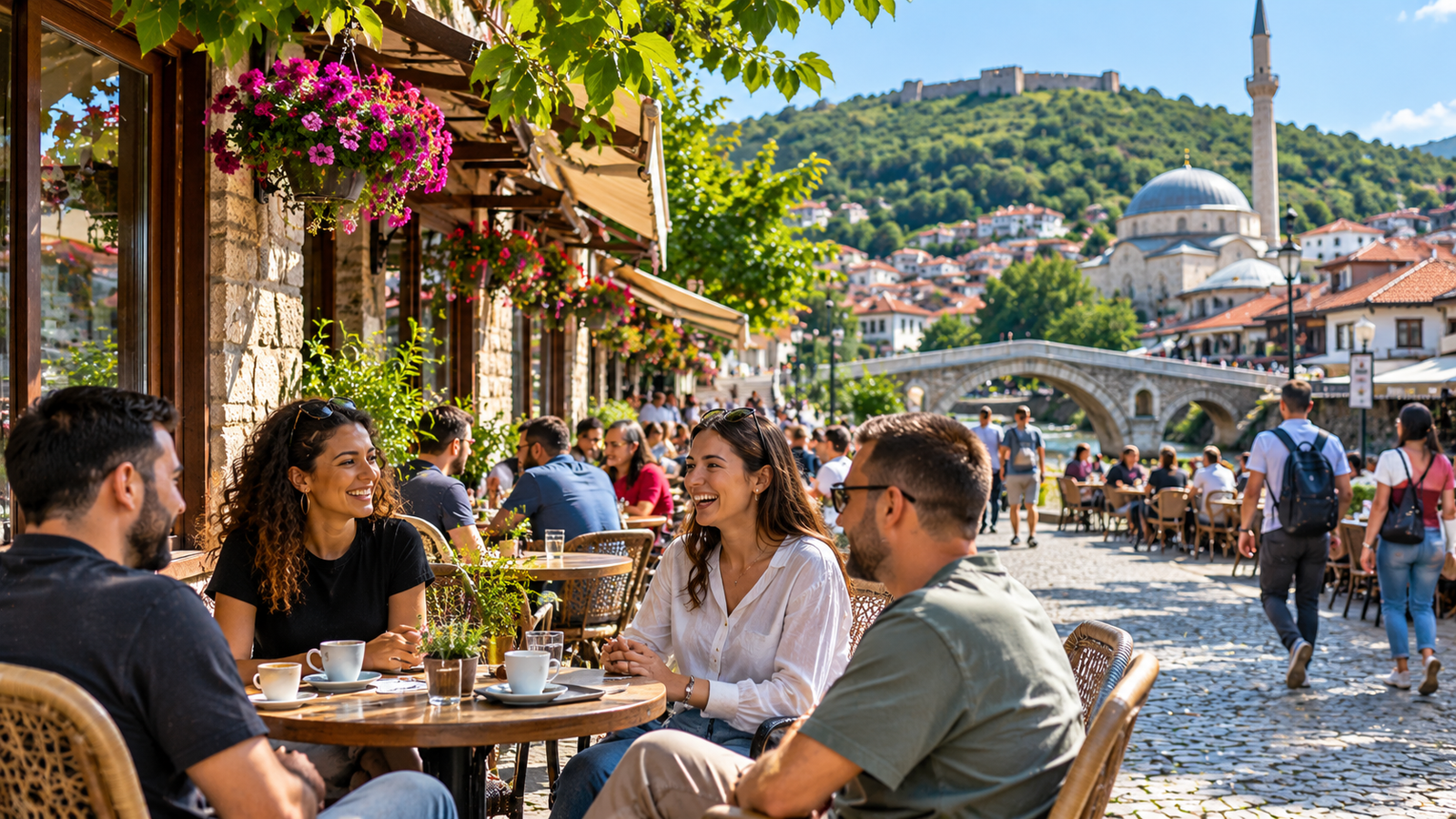
The featured image is AI-generated for illustrative purposes. It depicts fictional people enjoying coffee and conversation at an outdoor café in a scene inspired by historic Prizren, Kosovo. The people, café setting and architectural details are illustrative and do not represent an actual photographed gathering or documentary image of the city.
Editorial Disclaimer
This article combines official demographic data with general cultural descriptions and practical visitor guidance. Cultural observations are not statistical measures of personality or hospitality. The 2024 census figures use different population bases for certain tables, and participation was limited in four northern municipalities. Information was reviewed in November 2026.
[…] For an introduction to these communities, read our People in Kosovo guide. […]