Planning to apply for Kosovo citizenship in 2026? Whether you are a foreign resident, married to a Kosovo citizen, part of the Kosovo diaspora or seeking citizenship for a child, understanding the current law is essential before starting an application.
Kosovo introduced a new citizenship law in 2026. Law No. 10/L-023 on Citizenship of the Republic of Kosovo, published in the Official Gazette on May 6, 2026, replaced the previous Law No. 04/L-215.
The new legislation defines the conditions for acquiring, registering, reacquiring and losing Kosovo citizenship. It includes different routes for ordinary naturalization, spouses, diaspora members, children, refugees and stateless persons.
However, obtaining Kosovo citizenship is not the same as obtaining a residence permit, a citizenship certificate or a Kosovo passport.
This guide explains the main legal requirements, available application routes, supporting documents and important considerations under the 2026 framework.
Kosovo Citizenship in 2026: Quick Facts
| Question | General information |
|---|---|
| Current principal citizenship law | Law No. 10/L-023 |
| Official Gazette publication | May 6, 2026 |
| Previous citizenship law | Law No. 04/L-215 — repealed |
| Responsible authority | Ministry of Internal Affairs |
| Ordinary naturalization | Generally five years after obtaining permanent residence |
| Naturalization through marriage | Separate conditions apply |
| Diaspora citizenship | Special provisions under Article 15 |
| Multiple citizenship | Permitted under Kosovo law |
| Citizenship by descent | Recognized subject to legal conditions |
| Citizenship for children | Special registration and naturalization provisions |
| Applications abroad | Consular procedures may be available |
| Official legal source | Kosovo Official Gazette |
This guide reflects the legal framework reviewed on November 1, 2026. Individual eligibility, administrative requirements and implementing regulations must be confirmed with the competent authority.
1. What Is the New Kosovo Citizenship Law?
The current principal legislation is:
Law No. 10/L-023 on Citizenship of the Republic of Kosovo
The law was published in the Official Gazette on May 6, 2026, and entered into force 15 days after publication.
It replaced Law No. 04/L-215, which had governed citizenship since 2013.
The 2026 law regulates:
- Citizenship acquired through parentage
- Citizenship connected with birth in Kosovo
- Citizenship through adoption
- Naturalization of foreign nationals
- Naturalization through marriage
- Citizenship for diaspora members
- Citizenship involving refugees and stateless persons
- Reacquisition of citizenship
- Loss and revocation of citizenship
- Citizenship registration and administrative procedures
One particularly important provision is Article 32.
It allows existing implementing regulations to continue operating where they do not conflict with the new law, pending the adoption of updated regulations.
Consequently, older administrative instructions may still have procedural relevance, but they must not be treated as overriding the 2026 legislation.
Official source: Law No. 10/L-023 — Kosovo Official Gazette
2. How Can You Obtain Kosovo Citizenship?
Kosovo’s citizenship law recognizes several ways of acquiring citizenship.
The applicable route depends on the person’s background and legal circumstances.
| Citizenship route | Main consideration |
|---|---|
| Parentage | Citizenship status of a parent |
| Birth in Kosovo | Specific legal conditions, not birth alone |
| Adoption | Citizenship of an adopting parent |
| Ordinary naturalization | Permanent residence and additional requirements |
| Marriage | Marriage duration, lawful residence and other conditions |
| Diaspora | Birth, descent and qualifying connections with Kosovo |
| Refugee or stateless status | Special statutory requirements |
| Special state interest | Exceptional procedure |
| Reacquisition | Previously held Kosovo citizenship |
It is important to identify the correct route before preparing documents.
A person who may already qualify through parentage should not automatically assume that ordinary naturalization is the only option.
3. Kosovo Citizenship Through Ordinary Naturalization
Article 10 of Law No. 10/L-023 establishes the principal conditions for ordinary naturalization.
An adult foreign national applying through this route must satisfy several requirements.
Permanent Residence and the Five-Year Rule
The law generally requires at least five years of continuous residence in Kosovo after obtaining a permanent residence permit.
This is a significant distinction.
Five years of ordinary temporary residence should not automatically be treated as satisfying the requirement.
For example, someone who has lived in Kosovo for five years under temporary permits may not yet qualify through this provision.
Integration into Kosovo Society
Applicants must demonstrate integration through relevant social, cultural, scientific, economic or professional connections.
The assessment depends on the evidence and applicable administrative procedure.
Financial Resources
Applicants must demonstrate sufficient means to support themselves and their dependants without relying on social assistance schemes.
Financial Obligations
The law requires applicants to have fulfilled their financial obligations to the state.
Language and Knowledge Requirements
The legislation requires elementary reading and writing knowledge in one of Kosovo’s official languages, together with knowledge of its culture and social order.
There are statutory exceptions for certain applicants.
Additional General Conditions
Applicants must also satisfy the general naturalization provisions, including relevant legal and criminal-record requirements.
The full statutory framework should be considered rather than treating any single requirement as sufficient for approval.
4. Does Living in Kosovo for Five Years Guarantee Citizenship?
No.
The five-year period is only one requirement within the ordinary naturalization framework.
Applicants also need to meet other relevant conditions, including permanent residence status, integration, financial criteria and applicable legal requirements.
Example
A foreign national enters Kosovo in 2021 and receives temporary residence.
By 2026, that person may have spent five years in the country.
However, this does not automatically mean they have completed five years after obtaining permanent residence.
The date permanent residence was granted can therefore be essential.
Exceptional Two-Year Provision
Article 10 also provides a special possibility for certain adult foreign nationals holding permanent residence in exceptional circumstances.
Under the statutory conditions, the residence period following permanent residence may be two years rather than five.
This is not a general entitlement available to everyone.
Applicants should obtain an individual eligibility assessment before relying on the exception.
5. How Much Time Can You Spend Outside Kosovo?
The 2026 law addresses interruptions in residence.
Article 10 provides that the relevant residence may still be considered continuous where the person has spent periods outside Kosovo not exceeding ten months.
For longer absences, approval from the competent authority is required under the law.
The calculation and treatment of individual absences should be confirmed through the current administrative procedure.
Practical Advice
Keep records of your:
- Residence permits
- Entry and exit history
- Registered address
- Employment or business activity
- Other evidence relevant to your lawful residence
Do not assume that holding a residence card alone proves compliance with every continuity requirement.
6. Kosovo Citizenship Through Marriage
Marriage to a Kosovo citizen provides a separate naturalization route under Article 12.
A foreign spouse may apply where the statutory requirements are met.
The principal conditions include:
- Marriage to a Kosovo citizen for at least three years.
- Where the spouse became a Kosovo citizen through naturalization, at least three years since that naturalization.
- At least one year of regular residence in Kosovo with a valid residence permit.
- Compliance with the other applicable naturalization conditions, except for the ordinary five-year permanent-residence requirement.
Is Citizenship Automatic After Marriage?
No.
Marriage creates a possible legal route, but the foreign spouse must apply and satisfy the applicable conditions.
The marriage must also comply with the relevant family legislation.
Do You Need a Marriage Certificate?
Evidence of marriage is central to this route.
Depending on the circumstances, an applicant may need a Kosovo marriage certificate or properly recognized foreign marriage documentation.
Read our related guide:
How to Get a Marriage Certificate in Kosovo (2026)
7. Can Children Obtain Kosovo Citizenship?
The 2026 citizenship law includes separate provisions relating to children.
Citizenship Through a Parent
Article 6 addresses citizenship acquired through parentage.
Where at least one parent is a Kosovo citizen, the child may qualify under the legal conditions.
Special consent and registration rules may apply to a child born outside Kosovo, particularly where the parents hold different citizenships.
Citizenship Through Adoption
Article 8 provides for acquisition of citizenship by an adopted child where at least one adopting parent is a Kosovo citizen.
Children of Naturalized Citizens
Article 13 provides a route for minor children of naturalized citizens.
The application may be submitted together with or after the parent’s application.
For children aged 14 to 18, the law requires the child’s prior consent in the specified circumstances.
Important: A child being born in Kosovo does not automatically mean citizenship is granted to every child regardless of parental status. The law contains specific rules concerning birth in Kosovo and the risk of statelessness.
8. Kosovo Citizenship for Diaspora Members
Article 15 introduces specific provisions for eligible Kosovo diaspora members.
The law provides a naturalization route for qualifying persons who may not satisfy certain ordinary naturalization conditions.
The provision can apply to a person lawfully residing abroad who establishes the required Kosovo birth and family or economic connections.
It may also extend to direct descendants satisfying the applicable criteria.
What Should Diaspora Applicants Check?
- Whether they meet the statutory definition.
- Whether their Kosovo birth or family connection can be documented.
- Whether they have the relevant family or economic ties.
- Which supporting evidence is accepted.
- Which consular or civil-status office processes the application.
Article 15 delegates certain detailed criteria to implementing regulations.
A family surname or distant ancestral connection alone should not be assumed to establish eligibility.
9. Citizenship for Refugees and Stateless Persons
Article 14 provides a separate naturalization route involving people recognized as refugees or stateless persons.
It establishes a five-year residence requirement calculated from recognition of the relevant status, together with other specified conditions.
Special provisions also concern eligible family members and children.
The requirements differ from ordinary naturalization.
Applicants should obtain guidance from the Ministry of Internal Affairs or an appropriately qualified legal adviser familiar with the applicable protection status.
10. Exceptional Citizenship for Special Interest
Article 11 allows naturalization in exceptional cases involving Kosovo’s special interests.
The law refers to economic, social, cultural, sporting, scientific, political or professional interests, as well as humanitarian reasons.
Citizenship under this provision is granted by a decree of the President of Kosovo.
This is not a standard immigration programme and should not be marketed as a guaranteed investment-for-citizenship opportunity.
Paying money to a private intermediary does not establish eligibility.
11. Does Kosovo Allow Dual Citizenship?
Yes.
Article 4 of the 2026 law expressly permits Kosovo citizens to hold one or more additional citizenships.
It also provides that acquiring or possessing another citizenship does not, by itself, cause the loss of Kosovo citizenship.
Important Limitation
Kosovo’s permission to hold multiple citizenships does not establish that every other country permits the same arrangement.
Someone seeking to retain another nationality must also check the laws of that country.
A person should not assume that dual citizenship is automatically recognized under both legal systems.
12. What Documents Are Needed to Apply for Kosovo Citizenship?
The exact checklist depends on the citizenship route.
The Ministry of Internal Affairs publishes procedural guidance covering different applicant categories.
For ordinary naturalization, documents may include:
- Completed citizenship application form
- Valid passport and identification
- Birth certificate
- Marriage certificate, where applicable
- Evidence of permanent residence
- Proof of lawful residence history
- Evidence of accommodation
- Financial or income documentation
- Tax-related confirmations
- Criminal-record documentation
- Other evidence required for the specific route
Some foreign documents may require certified translation or authentication.
However, the ministry’s currently published procedural material includes instructions developed before the 2026 law.
Accordingly, applicants should obtain the current checklist for their exact legal route from the competent authority before gathering expensive documents.
Related KosovoScope Guides
Kosovo Criminal Record Certificate
Document Notarization and Legalization in Kosovo
13. How to Apply for Kosovo Citizenship Step by Step
Step 1: Identify Your Legal Route
Determine whether you may qualify through ordinary naturalization, marriage, parentage, diaspora, refugee status or another provision.
Step 2: Check the Current Requirements
Review Law No. 10/L-023 and contact the Ministry of Internal Affairs.
Confirm which administrative regulations and evidence rules apply to your situation.
Step 3: Obtain the Application Form
The ministry’s published instructions identify application forms available through municipal Civil Status Offices or Kosovo diplomatic and consular missions, depending on the case.
Confirm that the current form is appropriate under the new law.
Step 4: Collect Supporting Documents
Gather the necessary identification, residence, civil-status, financial and other documentation.
Check validity periods, translations and authentication requirements.
Step 5: Submit Your Application
Follow the filing procedure designated by the competent authority.
Some routes involve municipal Civil Status Offices, Ministry of Internal Affairs departments or diplomatic and consular missions.
Step 6: Respond to Additional Requests
Authorities may ask for clarification or additional documents.
Provide accurate information and retain copies of all submitted material.
Step 7: Receive the Official Decision
Citizenship is not established merely by submitting an application or receiving a payment receipt.
The competent authority must determine the application according to law.
Step 8: Complete Citizenship Registration
Where the applicable procedure requires a subsequent registration step, ensure the relevant decision is recorded in the official register.
Step 9: Apply for Identity Documents
Once citizenship has been legally acquired and the necessary registration completed, a person may be eligible to apply for Kosovo identity documents under the relevant rules.
Citizenship acquisition, identity-card issuance and passport issuance are separate administrative processes.
14. Where Can Applications Be Submitted?
The Ministry of Internal Affairs is the competent central authority for citizenship matters.
The filing location depends on the type of application and applicable procedure.
Relevant institutions may include:
- Ministry of Internal Affairs
- Municipal Civil Status Offices
- Kosovo embassies and consulates
The ministry’s published guidance identifies local and consular procedures for different categories.
Applicants living abroad should contact the Kosovo diplomatic or consular mission responsible for their location.
Official information: Ministry of Internal Affairs — Obtaining Kosovo Citizenship
15. How Long Does a Kosovo Citizenship Application Take?
The Ministry of Internal Affairs’ published procedural guidance refers to a 180-day decision period for certain citizenship acquisition applications.
However, that guidance was prepared under an earlier procedural framework.
The applicability of a particular decision period to an application under Law No. 10/L-023 must be checked.
Different routes, missing documentation or additional verification may affect the process.
Do not assume that citizenship is automatically granted when a stated processing period expires.
For a time-sensitive case, obtain confirmation of the current deadline and available remedies directly from the competent authority.
16. How Much Does a Kosovo Citizenship Application Cost?
The applicable fees depend on the service and citizenship route.
The Ministry of Internal Affairs states that administrative fees are established by the relevant ministerial fee decision.
Applications submitted through diplomatic or consular missions may also be subject to consular fees.
There may be separate expenses for:
- Civil-status certificates
- Criminal-record documentation
- Translations
- Document legalization
- Other required evidence
This guide does not provide a single universal citizenship application fee because the current tariff must be verified for the relevant procedure.
Request an official fee breakdown before making payments.
17. Can an Application Be Refused?
Yes.
Meeting one requirement does not necessarily establish eligibility for citizenship.
The competent authority assesses the full statutory criteria and supporting evidence.
Possible problems may involve:
- Insufficient qualifying residence
- Missing permanent residence status
- Incomplete or inconsistent documents
- Unfulfilled legal requirements
- Financial or criminal-record issues
- Incorrect reliance on a special citizenship route
- False information or concealed facts
Article 17 also provides for revocation of naturalization decisions obtained through false statements or concealed facts.
If an application is refused, review the written decision and the applicable legal remedies and deadlines.
Do not assume that an informal request for reconsideration replaces a formal appeal.
18. Citizenship vs Permanent Residence vs Citizenship Certificate
These terms should not be confused.
| Status or document | Meaning |
|---|---|
| Temporary residence permit | Authorization to live in Kosovo under specified conditions |
| Permanent residence permit | Longer-term immigration status under the relevant law |
| Kosovo citizenship | Legal bond of nationality with the Republic of Kosovo |
| Citizenship certificate | Official evidence of citizenship already recorded or established |
| Kosovo identity card | National identity document issued under its own legislation |
| Kosovo passport | Travel document issued to eligible citizens |
Obtaining a citizenship certificate is not the same as acquiring citizenship through naturalization.
Someone who is already a Kosovo citizen but needs documentary proof should ask the Civil Status Office or competent consular authority for the appropriate evidence of nationality.
The naturalization procedure is intended for people who need to acquire citizenship, not merely replace a certificate.
19. Common Kosovo Citizenship Application Mistakes
Counting Temporary Residence as Permanent Residence
The ordinary naturalization period under Article 10 generally begins after obtaining permanent residence.
Using the Repealed 2013 Law
Law No. 04/L-215 is no longer the principal citizenship law.
Assuming Marriage Automatically Grants Citizenship
Marriage-based naturalization still requires an application and compliance with statutory conditions.
Treating Diaspora Eligibility as Automatic
Applicants must demonstrate the relevant connections and comply with the applicable procedure.
Ignoring Foreign Citizenship Rules
Kosovo permits multiple citizenships, but another country may impose separate restrictions.
Using Unofficial Agents
Avoid paying anyone who guarantees citizenship without an official legal basis.
Submitting Inaccurate Documents
False statements and concealed information can have serious legal consequences.
20. Kosovo Citizenship Application Checklist
Before beginning the process:
- Identify the relevant citizenship route.
- Read Law No. 10/L-023.
- Confirm which implementing regulations currently apply.
- Verify residence and eligibility requirements.
- Prepare valid identification.
- Obtain required civil-status certificates.
- Check financial and tax documentation.
- Obtain criminal-record documents where necessary.
- Confirm translation and legalization requirements.
- Verify the current fee.
- Identify the competent filing office.
- Submit the official application.
- Keep the application acknowledgment.
- Respond to requests for further evidence.
- Review the final decision.
- Complete any required citizenship-registration steps.
Frequently Asked Questions
How can I get Kosovo citizenship in 2026?
The available route depends on your circumstances. Law No. 10/L-023 governs citizenship through parentage, naturalization, marriage, diaspora provisions and other specified categories.
What is the new Kosovo citizenship law?
Law No. 10/L-023, published May 6, 2026, replaced Law No. 04/L-215.
Can I get Kosovo citizenship after five years?
Ordinary naturalization generally requires five years of continuous residence after receiving permanent residence, plus other statutory conditions.
Does temporary residence count toward the five-year period?
The ordinary naturalization provision refers to residence after obtaining a permanent residence permit. Temporary residence alone should not be assumed to satisfy it.
Can I obtain Kosovo citizenship through marriage?
A separate route exists. Article 12 includes a three-year marriage requirement, a lawful-residence requirement and additional conditions.
Does Kosovo allow dual citizenship?
Yes. Article 4 allows multiple citizenship. Applicants must also check the laws of any other country involved.
Can children acquire Kosovo citizenship?
Yes, subject to the rules governing parentage, birth, adoption and naturalization of minor children.
Can Kosovo diaspora members apply?
Yes. Article 15 creates a special route for eligible diaspora members and certain descendants.
Can I obtain citizenship by investing in Kosovo?
The law contains an exceptional special-interest procedure, but it does not establish an ordinary guaranteed citizenship-by-investment product.
Can I apply from abroad?
Certain applications may be accepted through Kosovo diplomatic and consular missions. Confirm the procedure for your legal category.
What documents are needed?
Requirements depend on the route. They may include identity documents, residence evidence, civil-status certificates, financial documents and criminal-record information.
Is a permanent residence permit the same as citizenship?
No. Permanent residence is an immigration status, while citizenship is nationality.
Is a citizenship certificate the same as citizenship?
No. A certificate is evidence of an existing status; naturalization is a legal process for acquiring that status.
How long does it take?
The ministry’s published guidance references 180 days for certain procedures, but applicants should confirm the currently applicable period under the 2026 framework.
Where can I find the official law?
The legislation is available through the Kosovo Official Gazette.
Final Thoughts
The most important development for Kosovo citizenship in 2026 is the adoption of Law No. 10/L-023.
Foreign residents, spouses of Kosovo citizens, members of the diaspora and other applicants should identify the correct citizenship route before preparing an application.
For ordinary naturalization, particular attention should be paid to the permanent residence requirement and the additional conditions involving integration, financial resources and knowledge of Kosovo’s official languages and society.
Although some existing administrative procedures remain relevant, the 2026 law must take priority where older instructions conflict with it.
For accurate guidance on an individual application, contact the Ministry of Internal Affairs or the appropriate Kosovo diplomatic or consular mission.
Last researched: November 1, 2026. This guide provides general legal and administrative information, not individual immigration or nationality advice. Verify the current law, implementing regulations and application requirements with the competent authorities.
Official Sources & References
- Kosovo Official Gazette — Law No. 10/L-023 on Citizenship of the Republic of Kosovo
- Kosovo Official Gazette — Issue No. 7/2026, May 6, 2026
- UNHCR Refworld — English Text of Law No. 10/L-023
- Ministry of Internal Affairs — Obtaining Kosovo Citizenship
- Official Gazette — Administrative Instruction No. 05/2020 on Citizenship Acquisition Procedures
- Kosovo Assembly — Legislative Record for Law No. 10/L-023
- Kosovo Ministry of Internal Affairs
Photo Credits & Image Disclosure
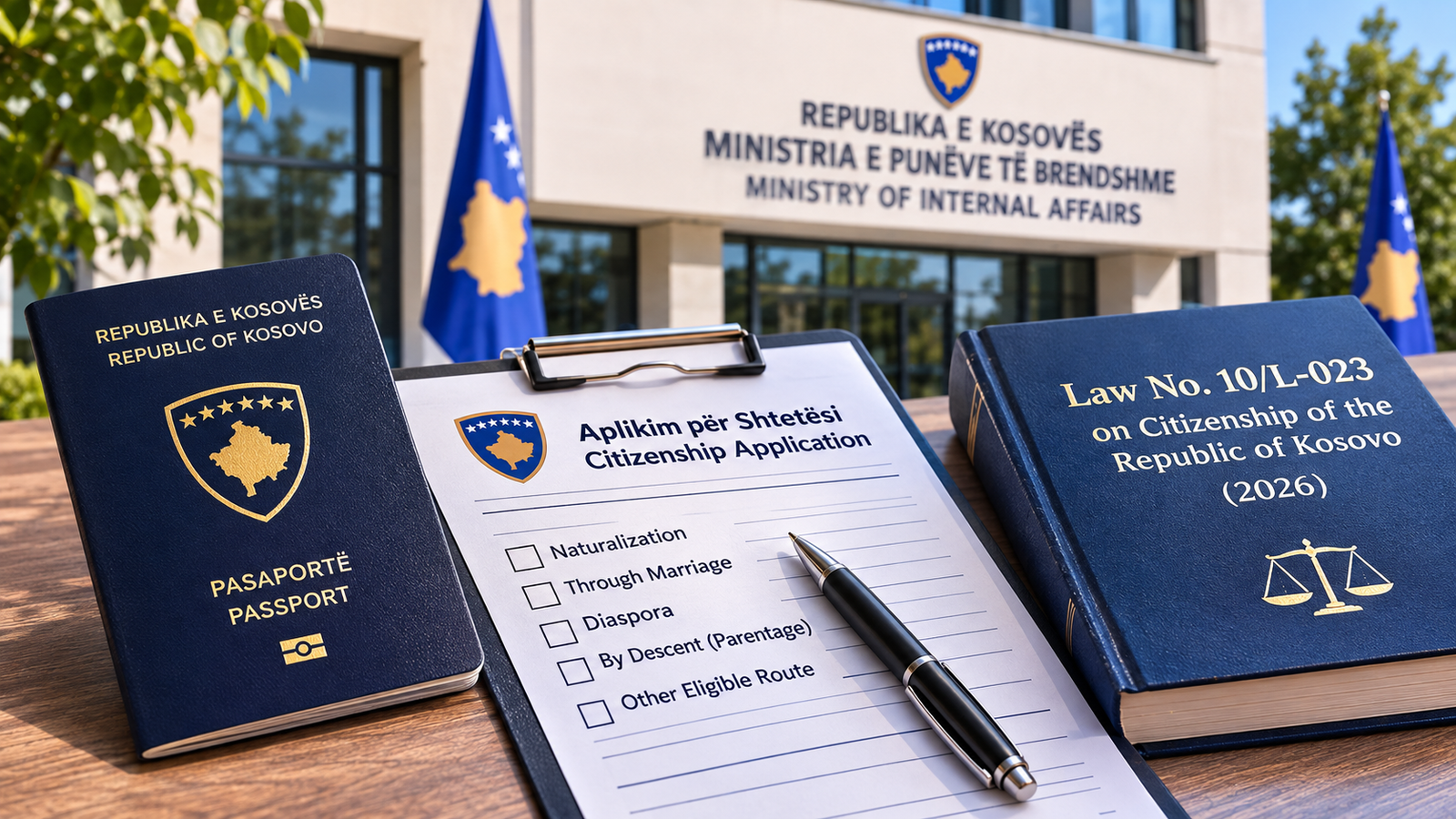
The featured image is an AI-generated editorial illustration created for KosovoScope. It depicts a fictional Kosovo passport, citizenship application form, law book and Ministry of Internal Affairs building. The documents, institutional symbols and government building are illustrative and do not represent authentic official records or verified government facilities.
[…] How to Get Kosovo Citizenship in 2026 […]