Waste collection in Kosovo is a basic public service, but the way it works can vary considerably between municipalities.
For someone moving to Kosovo, renting an apartment, buying property or opening a business, the practical questions are usually simple:
Who collects the waste?
How often is it collected?
Who pays the fee?
Can household waste be recycled?
What should you do with furniture, electronics or construction waste?
Kosovo has made progress in expanding municipal waste collection, but recycling and waste separation remain much less developed than in many Western European countries.
The Kosovo Environmental Protection Agency’s latest municipal-waste report states that 468,111.5 tonnes of waste were deposited in sanitary landfills in 2024, down around 4.9% from 2023. At the same time, the report notes that source separation and recycling remain limited and that municipalities still face difficulties dealing with bulky, construction and other special waste. ammk-rks.net
This 2026 guide explains how household waste collection works in Kosovo, municipal responsibilities, fees, recycling, bulky waste, electronic waste, plastic bags and practical rules for residents and businesses.
Who Is Responsible for Waste Collection in Kosovo?
Waste management in Kosovo is shared between several levels.
Municipalities play a major role in organizing local waste collection and service coverage.
Regional or municipal waste-management companies then collect household waste, while Kosovo’s central institutions regulate the legal framework and environmental standards.
The Kosovo Environmental Protection Agency monitors and reports on municipal waste management across the country. ammk-rks.net
In practice, this means your waste provider depends on where you live.
A resident of Pristina may deal with a different collection company from someone living in Prizren, Peja or Gjakova.
What Law Regulates Waste in Kosovo?
The main legal framework is Kosovo’s Law No. 04/L-060 on Waste, which has been amended several times.
The law covers areas including:
- Waste collection
- Transport
- Storage
- Treatment
- Recovery
- Disposal
- Hazardous waste
- Municipal responsibilities
The law was supplemented in 2022 and again through broader administrative-procedure amendments in 2024. Gazeta Zyrtare
Additional administrative instructions regulate specific waste categories such as packaging, hazardous waste and storage.
Who Collects Household Waste?
Municipal household waste is usually collected by a regional or municipal public waste company or another contracted operator.
Collection systems commonly use:
- Shared neighborhood containers
- Building containers
- Individual bins
- Scheduled truck collection
The exact system depends on the municipality and neighborhood.
Dense apartment areas are more likely to use shared containers, while houses may have individual or street-level collection arrangements.
How Often Is Waste Collected?
There is no single nationwide collection schedule.
Frequency can depend on:
- Municipality
- Neighborhood
- Population density
- Type of property
- Local operator
- Season
Central urban areas generally receive more frequent collection than sparsely populated rural areas.
If you are moving into a property, ask:
- Where are the nearest containers?
- Which days are collection days?
- Are bins shared?
- Who pays the waste fee?
These questions are particularly important in houses outside city centers.
How Much Does Waste Collection Cost?
There is no single Kosovo-wide household waste fee.
Municipalities and local service arrangements can have different tariffs.
The waste-management sector is designed around a cost-recovery model, meaning households and businesses contribute toward the cost of collection, transport and disposal.
Because tariffs may change and differ between municipalities, KosovoScope should avoid giving one fixed national monthly figure.
Before moving into a property, check the current tariff with:
- Your municipality
- Local waste company
- Landlord
- Building administrator
Who Pays the Waste Fee: Tenant or Landlord?
This depends on the rental agreement.
In some apartments, the landlord may continue paying the account and include it in rent or building charges.
In others, the tenant pays directly.
Before signing a lease, ask:
- Is the waste fee included?
- Whose name is on the account?
- Are there previous unpaid bills?
- How is payment made?
Do not assume waste collection is automatically included in rent.
Waste Collection in Apartment Buildings
In apartment buildings, waste is usually disposed of in common containers located:
- Beside the building
- In a designated collection area
- Along a nearby street
The building administrator may manage common-area cleanliness, but normal household waste collection is typically handled through the municipal waste system.
One practical issue is overflow.
If containers regularly overflow, ask residents whether the problem is temporary or common in that neighborhood.
Waste Collection for Houses
For detached houses, collection arrangements can be more individual.
Depending on location, you may have:
- Your own bin
- A shared street container
- Scheduled collection from the property
Before renting a house outside the urban center, verify that the street is actually included in regular municipal collection.
Waste Collection Coverage in Kosovo
Kosovo has been working to increase access to formal municipal waste collection.
Government waste-management policy documents set targets to increase the percentage of the population covered by municipal collection from around 90% in 2021 to 99% by 2026. mmphi.rks-gov.net
That target shows the direction of policy, but service quality can still vary significantly at local level.
What Happens to Household Waste?
Most ordinary municipal waste is transported to disposal facilities.
Kosovo still relies heavily on landfill disposal.
KEPA reported that approximately 468,111 tonnes of municipal waste were deposited in sanitary landfills during 2024. ammk-rks.net
The same report notes operational challenges at some landfill facilities, including inadequate waste separation, gas management and other environmental issues.
This is one reason Kosovo continues to emphasize modernization of the waste-management sector.
Is Recycling Available in Kosovo?
Yes, but it is still limited.
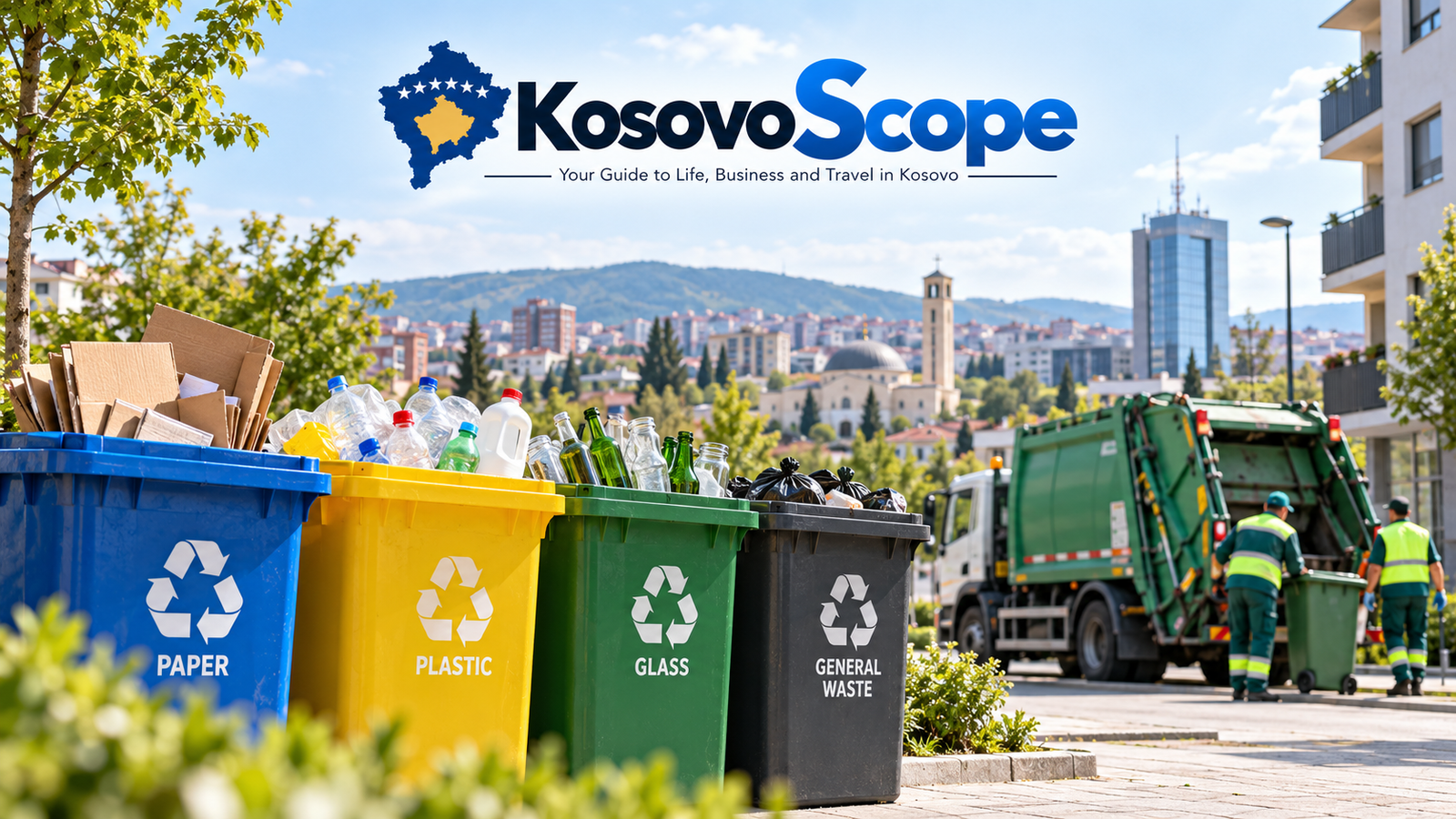
Recycling infrastructure is much less standardized than in countries where every household has separate bins for:
- Paper
- Plastic
- Glass
- Metal
- Organic waste
KEPA’s 2023–2024 report states that municipalities had not made significant progress with source separation, which is the first step required for large-scale recycling. ammk-rks.net
So visitors and new residents should not expect a uniform national recycling system.
Can You Separate Waste at Home?
You can, but finding formal collection channels may require local research.
Depending on the city, private recyclers or informal collectors may accept:
- Cardboard
- Paper
- Plastic
- Aluminum
- Scrap metal
- Certain electronic items
KEPA notes that some private operators collect separated waste, although part of the process continues through the informal sector. ammk-rks.net
Recycling Plastic
Plastic remains one of Kosovo’s important waste-management challenges.
Kosovo has introduced stronger packaging rules and measures designed to reduce single-use plastic.
KEPA links recent changes in plastic-bag use and trade partly to implementation of the updated Packaging and Packaging Waste rules. ammk-rks.net
However, plastic recycling is not yet universally available through household curbside collection.
Plastic Bag Charge
Kosovo has introduced a charge on certain plastic shopping bags.
KEPA’s municipal-waste report notes a €0.05 charge per plastic bag, linked to measures intended to reduce consumption of single-use plastic. ammk-rks.net
Reusable shopping bags are therefore useful both environmentally and economically.
Packaging Waste
Kosovo updated its packaging-waste framework through Administrative Instruction No. 04/2025, amending the previous packaging rules.
The broader policy direction is toward:
- Extended Producer Responsibility
- Increased packaging recovery
- More recycling
- Reduced landfill use
The national waste strategy includes ambitious targets for packaging recycling and recovery by 2030. Gazeta Zyrtare
Deposit Return System
Kosovo has also been working toward a deposit-return system for bottles and cans.
KEPA described implementation as being in an early phase in its latest municipal-waste report. ammk-rks.net
Once fully developed, such a system could allow consumers to return eligible beverage containers in exchange for a deposit refund.
Until the system becomes widespread, availability may remain limited.
Glass Recycling
Glass can be recycled, but municipal collection options vary.
Do not assume that ordinary street containers include a dedicated glass-recycling stream.
If you generate significant amounts of glass, such as through a restaurant or bar, ask your local municipality or a private recycling company about collection options.
Paper and Cardboard
Paper and cardboard can be easier to recycle commercially because they have resale value.
Businesses generating large amounts of:
- Cardboard boxes
- Office paper
- Packaging
may be able to arrange collection with private operators.
Households may also see informal collectors recovering cardboard before waste reaches the landfill.
Metal Recycling
Scrap metal has an established economic value.
Private collectors and recycling businesses may accept:
- Iron
- Aluminum
- Copper
- Other metals
Do not place large metal objects beside ordinary household containers unless the municipality specifically allows it.
Electronic Waste
Electronic waste includes:
- Computers
- Phones
- TVs
- Printers
- Chargers
- Small appliances
- Other electronics
These items should ideally not be mixed with ordinary household waste.
Electronic products may contain materials that should be recovered separately and components that can create environmental risks.
Before disposing of electronics, check whether:
- The retailer offers take-back
- A private recycler accepts them
- Your municipality has a collection program
Batteries
Batteries should also be separated from normal household waste where possible.
This includes:
- Household batteries
- Laptop batteries
- Phone batteries
- Power-tool batteries
Certain batteries contain chemicals that should not be placed into ordinary landfill waste.
Large Appliances
Items such as:
- Refrigerators
- Washing machines
- Ovens
- Air conditioners
should not simply be abandoned next to street containers.
Ask the municipality, waste company or appliance retailer about collection or disposal options.
Retailers may sometimes remove an old appliance when delivering a new one.
Furniture and Bulky Waste
Bulky waste is one area where Kosovo municipalities still face difficulties.
KEPA specifically identifies bulky waste infrastructure as a weakness in many municipalities. ammk-rks.net
Bulky waste includes:
- Sofas
- Mattresses
- Wardrobes
- Tables
- Large furniture
Do not assume that putting a sofa beside an ordinary container means it will be collected automatically.
Contact the local waste company first.
Renovation and Construction Waste
Construction waste must be handled differently from normal household waste.
Examples include:
- Concrete
- Bricks
- Tiles
- Plasterboard
- Wood
- Demolition material
If renovating an apartment or house, ask the contractor how the waste will be removed.
Make disposal responsibilities part of the renovation agreement.
Never Dump Construction Waste in Household Containers
Using normal residential containers for large renovation waste can:
- Overflow the container
- Damage collection equipment
- Create conflict with neighbors
- Violate municipal rules
For major works, arrange dedicated transport or an appropriate container.
Hazardous Household Waste
Hazardous materials require special care.
Examples include:
- Paint
- Solvents
- Chemicals
- Pesticides
- Motor oil
- Certain cleaning products
Kosovo has separate regulations governing hazardous waste. Gazeta Zyrtare
Never pour chemicals into drains or dispose of large amounts with normal household waste.
Medical Waste
Medical waste from hospitals and clinics is subject to specialized handling.
Households also need to be careful with:
- Needles
- Syringes
- Certain medicines
Do not leave sharps loose inside normal rubbish bags.
Ask a pharmacy or healthcare provider about safe disposal where necessary.
Illegal Dumping
Illegal dumping remains an environmental problem in some areas of Kosovo.
KEPA monitors illegal dumpsites as part of its municipal-waste reporting.
A digital national waste-reporting platform was launched in 2025 to improve monitoring and give authorities a clearer picture of illegal dumpsites and waste indicators. ammk-rks.net
Avoid using unofficial dumping areas even if you see other people doing it.
Can You Report Illegal Waste?
If you see illegal dumping, depending on the situation you may contact:
- Municipality
- Municipal inspectorate
- Waste company
- Environmental authorities
Providing the exact location and photographs can make reports more useful.
Waste and Renting an Apartment
Before renting, check:
- Where waste containers are located
- How frequently they are emptied
- Whether the waste fee is included
- Whether the building has recycling arrangements
- Whether the surrounding area is clean
This can tell you a lot about how well the building and neighborhood are managed.
Link this section to your Renting an Apartment in Kosovo guide.
Waste and Buying Property
Waste collection should also be considered when buying property.
Check:
- Formal municipal collection coverage
- Location of containers
- Outstanding service debts
- Accessibility for collection trucks
- Illegal dumping nearby
For rural property, this becomes even more important.
Link this section to Buying Property in Kosovo.
Rural Waste Collection
Rural collection may be less frequent than in city centers.
If you are considering a rural house or farm, ask neighboring residents:
- Which company collects waste?
- How often?
- Where is the collection point?
- Is there a household fee?
Never assume rural waste can simply be burned or dumped on private land.
Should You Burn Household Waste?
No.
Burning mixed household waste can release harmful pollutants, particularly when plastics and synthetic materials are involved.
It may also create:
- Fire risk
- Smoke complaints
- Environmental contamination
Use formal waste collection wherever available.
Organic Waste
Food and garden waste represent another opportunity for better waste management.
Households with gardens may consider composting:
- Vegetable scraps
- Fruit scraps
- Coffee grounds
- Leaves
- Grass
- Certain garden waste
Avoid adding:
- Plastics
- Glass
- Chemicals
- Large amounts of meat
- Hazardous material
Composting can reduce the amount of household waste sent to landfill.
Garden Waste
Garden waste such as:
- Branches
- Leaves
- Grass
may require a separate arrangement depending on the municipality.
For large volumes, contact your local waste operator rather than filling ordinary neighborhood containers.
Waste for Businesses
Businesses may have different needs and tariffs from households.
Restaurants, shops and offices may generate much larger quantities of waste.
Businesses should consider:
- Collection contract
- Container size
- Collection frequency
- Recycling
- Packaging waste
- Food waste
A business producing large volumes should not rely on small household containers.
Restaurants and Food Businesses
Restaurants generate:
- Food waste
- Packaging
- Glass
- Cardboard
- Cooking oil
Used cooking oil should ideally be collected separately rather than poured into drains.
Businesses should investigate licensed collection options where available.
Offices
Office waste can be relatively easy to separate.
A simple system might include:
- Paper/cardboard
- Plastic bottles
- General waste
- Electronic waste
Even if municipal recycling is limited, segregating valuable materials can make private collection easier.
Retail Businesses
Retailers generate significant amounts of cardboard and packaging.
Flatten cardboard boxes and investigate whether a local recycler or collector can recover them.
This may reduce pressure on normal municipal containers.
Waste Collection and Cost of Living
Waste collection is usually a relatively small part of total household costs compared with:
- Rent
- Electricity
- Heating
- Food
- Internet
But it should still be included when estimating monthly living expenses.
Link this section to your Cost of Living in Kosovo guide.
Kosovo’s Recycling Targets
Kosovo’s waste-management strategy sets longer-term goals for:
- Controlled waste management
- Improved municipal collection
- Higher recycling
- Packaging recovery
- Circular economy
The policy framework aims for 100% of municipal solid waste to be managed in controlled facilities by 2030, alongside substantially higher recovery and recycling rates for packaging waste. mmphi.rks-gov.net
These are strategic targets rather than a description of today’s household recycling system.
Why Recycling Is Still Limited
There are several challenges:
- Limited source separation
- Insufficient infrastructure
- Dependence on landfill disposal
- Uneven municipal capacity
- Informal waste collection
- Limited consumer habits
KEPA’s latest report states clearly that municipalities still have significant work to do on source separation and circular-economy systems. ammk-rks.net
What Residents Can Do Now
Even without a perfect national recycling system, households can:
- Use reusable shopping bags
- Reduce disposable packaging
- Separate cardboard
- Recycle scrap metal
- Use electronic-waste collection where available
- Compost organic waste
- Donate usable furniture
- Repair instead of immediately replacing products
Reducing waste is often easier than recycling it later.
Donate Instead of Throwing Away
If furniture, clothing or electronics still work, consider:
- Family
- Friends
- Local community groups
- Charities
- Online marketplace groups
A usable item does not need to become landfill waste.
Moving House
Moving often creates large amounts of waste.
Plan disposal before moving day.
Separate:
- Usable items
- Recyclables
- Electronics
- Furniture
- General waste
Do not leave everything beside the nearest container.
Practical Waste Checklist for New Residents
When you move into a new property:
Collection
Identify the local waste company.
Containers
Find the nearest bins.
Schedule
Ask when collection happens.
Fees
Confirm who pays.
Debt
Check whether there are unpaid bills where relevant.
Recycling
Identify any local recycling options.
Bulky waste
Ask how furniture should be removed.
Electronics
Find an appropriate collection route.
This takes very little time and makes daily life easier.
Common Waste Mistakes
Avoid:
- Dumping furniture next to regular bins
- Putting renovation rubble in household containers
- Burning mixed household waste
- Throwing electronics into normal rubbish
- Assuming every municipality has the same fees
- Assuming recycling systems are identical everywhere
- Ignoring unpaid service bills
- Using unofficial dumping areas
Is Kosovo Improving Its Waste System?
There are signs of progress, but significant challenges remain.
Waste deposited at sanitary landfills fell from about 493,116 tonnes in 2023 to 468,112 tonnes in 2024, according to KEPA. ammk-rks.net
Kosovo has also:
- Updated packaging regulations
- Introduced measures to reduce plastic-bag use
- Developed digital waste reporting
- Planned integrated waste-management infrastructure
- Continued working toward greater recycling and circular-economy systems
At the same time, KEPA says source separation, recycling infrastructure and management of special waste still require considerable improvement. ammk-rks.net
Final Thoughts
Waste collection in Kosovo is widely available in urban areas and continues to expand, but the system still relies heavily on landfill disposal.
For residents, the most important practical points are:
- Waste collection is organized locally rather than through one nationwide household provider.
- Fees vary by municipality and service arrangement.
- Recycling exists but household source separation is still limited.
- Large furniture, electronics and construction waste should not be treated like ordinary household rubbish.
- Kosovo is gradually introducing stronger packaging, recycling and circular-economy policies.
The latest official municipal-waste report shows both progress and remaining challenges: landfill volumes declined in 2024, but recycling and source separation are still far from fully developed. ammk-rks.net
For someone moving to Kosovo, one simple rule works well:
Find out how waste is collected in your exact municipality and neighborhood rather than assuming the system is the same everywhere.